Conseils
The real cost of Umrah: a complete budget breakdown
Almanasiq Editorial Team · Published 2026-02-03
The real cost of Umrah is the total cost of your particular journey, not a headline package price or a universal euro estimate. Build a budget using current quotes, clear inclusions and a contingency, whether you depart from Europe, the UK, Canada or the US.
The real cost of Umrah is the total cost of your particular journey, not a headline package price or a universal euro estimate. Build a budget using current quotes, clear inclusions and a contingency, whether you depart from Europe, the UK, Canada or the US.
Visa, application charges and insurance
Identify the route before budgeting
Start with the permission that fits your passport, status and proposed journey. Visa eligibility is not determined simply by the airport you depart from. An overseas resident with a different nationality may follow a different process from a citizen of the same country.
Do not assume every European or North American traveller must use Nusuk for a tourist eVisa, or that every South Asian passport holder has exactly the same route. Use the relevant official service and its current eligibility check. An agency may help, but its fee and responsibilities should be clear.
Write down the application charge, compulsory insurance if included or required, any processing charge and the agency’s separate service fee. Record the currency and date of the quote. A package advertised as “visa included” still needs a written statement of what happens if the visa is refused.
Do not budget with an old fixed fee
The Visit Saudi service terms say fees are shown during the application and may change. A past 535 SAR or euro equivalent should not be treated as a guaranteed current price. Payment is not approval, and the service’s refund conditions matter if the application is unsuccessful.
Allow for any legitimate appointments, document preparation or processing steps that actually apply. Do not add a universal biometric-centre fee, translation bill or premium Nusuk charge without establishing that it is required for your route. Conversely, do not leave a necessary charge outside the comparison because it is collected by another provider.
Understand what insurance covers
Read the policy, not just the word “insured”. Ask about emergency treatment, declared medical conditions, repatriation, trip cancellation, missed connections and activities on the itinerary. A policy supplied with a visa is not automatically equivalent to a comprehensive travel policy.
Check excesses, limits, exclusions and assistance contacts. Ask whether current government travel advice affects cover before paying for the trip. Keep a copy of the answers. A small cash reserve cannot substitute for appropriate cover, and insurance should not be assumed to reimburse every change of plan.
Treat the application and insurance timeline as part of the budget. Non-refundable flights bought before uncertainty is resolved create a financial risk, even if the fare itself is attractive. See the visa comparison for separating the route from the package.
Flights: compare the total ticket cost
Use your actual departure options
Collect comparable quotes from airports you can realistically reach. Include the journey to the airport, parking or rail, any overnight stay, checked bags, seat selection and necessary transit documents. A low headline airfare may exclude several of those costs.
For Europe and the UK, a departure from a different city may save on the flight but add a train, hotel and extra time. For Canada and the US, a domestic positioning flight may introduce another checked-bag fee and a separate-ticket connection. Compare the full journey in your home currency, not a generic Europe-versus-America price band.
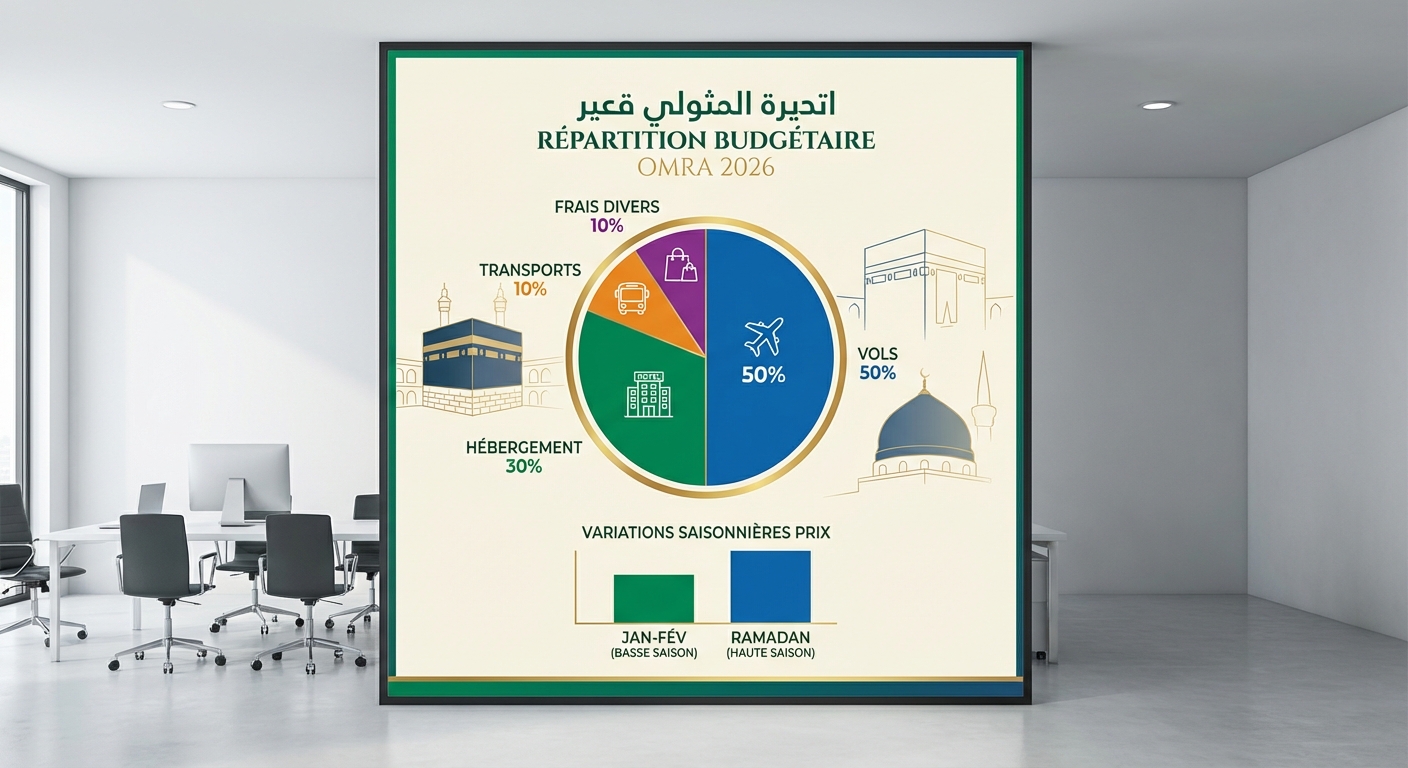
Do not assume flights always make up half of the budget. For one traveller they may dominate; for a family sharing rooms or travelling in a costly hotel period, accommodation can be equally important. Use the actual totals instead of forcing them into preset percentages.
Direct flights, connections and arrival city
Compare Jeddah and Madinah only after considering your intended city order and transfers. An apparently cheaper arrival can require an extra hotel night or an awkward cross-country journey. For travel towards Makkah, include the practical requirements of ihram and the miqat in your plan.
For a connection, establish whether the tickets form one protected itinerary, whether bags are checked through and whether you must enter the transit country. A longer connection can be cheaper, but a self-transfer should not be evaluated as if the airline guaranteed the onward flight.
Include the return journey just as carefully. Leaving a distant hotel late at night or connecting from a train to an international flight may require paid transport and extra margin. Saving on one fare while risking a missed flight is not necessarily a lower-cost trip.
Booking timing without a “golden window”
Compare dates and set a price you can afford, but do not rely on a universal three-to-six-month rule or guaranteed Tuesday discount. School holidays, capacity, demand and booking conditions all affect an actual offer.
January and February do not permanently correspond to Rajab and Sha’ban: the Islamic calendar moves through the Gregorian year. Nor is an indirect flight always cheaper or a summer ticket always a bargain. Use current searches for dates you can genuinely travel, and note when each quote expires.
Keep the fare conditions alongside the price. A slightly higher fare with useful flexibility may compare differently once your visa or leave arrangements are considered. That does not mean buying every add-on: purchase only the benefits you understand and need.
Hotels: the cost of a usable location
Compare the real route to the mosque
A hotel’s distance should mean the usable route from its entrance to the entrance you will use—not a straight line to the edge of a mosque complex. Slopes, crossings, crowds, lifts and temporary barriers can affect effort and time.
There is no official universal A/B/C price zone that guarantees a particular nightly rate or walk. A nearby property may still involve queues and long internal circulation. A more distant property may suit some travellers if its shuttle is confirmed, but not everyone can comfortably use it.
Prioritise what matters to your party: an accessible entrance, suitable beds, bathroom layout, room occupancy and a reliable return route. Compare a room’s total cost with the actual number of occupants rather than multiplying a per-person package headline by the wrong group size.
Separate room rate from the full stay
Check taxes, breakfast or other meals, cancellation terms, early arrival and late departure. Record both the nightly rate and the total for every booked night. A flight leaving after midnight can easily create confusion about the final room night.
Confirm bed configuration and whether a quoted child price includes a separate bed. Ask about connecting rooms if essential; a request is not a guarantee. Compare the same occupancy and meal basis across properties.
Room sharing can lower the per-person cost, but privacy, sleep and accessibility still matter. Do not choose a room arrangement that makes the journey unsuitable merely to meet an advertised budget.
Budget Madinah separately
Do not assume Madinah is always cheaper or always more expensive than Makkah. Price the exact dates and location, including the approach to the mosque and the relevant women’s entrances where needed. Old hotel-count statistics do not establish what your room will cost.
Keep the two hotel totals separate so you can see the effect of changing the number of nights in each city. Check whether a move adds luggage handling, transfers, waiting or a gap between checkout and check-in.
Package and independent hotel bookings
If your dedicated visa or service package requires approved accommodation arrangements, follow those conditions. Do not generalise that requirement into a claim that every tourist-visa traveller must book every hotel through one platform.
Ask before changing a package-linked hotel. Establish what can be changed, whether permission or repricing is needed and how the change is confirmed. See the Makkah neighbourhood and distance guide and the Madinah hotel guide when comparing locations.
Ground transport: count every transfer
Airport and station transfers
List the actual airport terminal or station, destination hotel, group size and bags. Ask whether a quote covers the whole vehicle or one passenger, and whether waiting or a late arrival costs extra. An “airport transfer” inclusion should name both ends and the responsible provider.
Do not use a supposed standard Jeddah–Makkah taxi price as a guaranteed quote. Compare licensed services and the full conditions. Sharing a suitable vehicle can reduce the cost per person, but its seats and luggage capacity must fit the group.
The Haramain network includes an airport station distinct from Jeddah’s city station. Check the appropriate service for your terminal and date rather than assuming everyone must first travel to the city station. Rail also needs an onward transfer at the other end.
Makkah–Madinah and local journeys
For rail, add all passengers’ fares plus transfers to and from the stations. For a private transfer, check the complete vehicle quote. For a coach, verify its real departure and arrival stops. Use date-specific timetables; Makkah–Madinah is not a 45-minute train journey.
Local transport depends heavily on where you stay. Check the hotel shuttle’s actual schedule and whether it is included. Budget for a realistic backup if a bus is full or the return point changes. Public buses, hotel shuttles and seasonal services should not be treated as interchangeable free transport.
Optional visits and accessibility
For ziyarat outings, identify the stops, duration, guide language, inclusions and return time. An excursion advertised by one agency is not automatically part of another package. Avoid paying separately for a service already included, and avoid assuming a quoted visit covers meals or all admissions.
If you need an accessible vehicle, price and confirm it explicitly. Driver assistance with an ordinary car is not the same as a vehicle accommodating an occupied wheelchair. Do not put this cost into a vague “extras” allowance that disappears when comparing packages.
See the Makkah transport guide and the Haramain booking guide before completing this part of the budget.
Nusuk packages, independent bookings and permits
Understand the product on offer
Nusuk Umrah offers visa-inclusive packages, packages without a visa and options for tailored arrangements through approved providers. Availability depends on the traveller’s profile. The existence of those choices does not mean that all travellers follow one identical booking sequence.
Read the actual package details. “Comprehensive” should be checked against named flights, hotels, meals, transfers, guidance and exclusions. A starting price on a search page may depend on dates and occupancy that differ from yours.
For the multiple-entry Umrah product announced in July 2026, per-visit package and permit requirements matter. Do not price a second visit as if an already-issued visa were the only requirement. Verify the current product conditions directly rather than extrapolating from a tourist eVisa.
Compare package and independent totals fairly
Create two columns containing the same travel dates, hotel nights, occupancy, baggage, transfers and support. For each line, mark “included”, “separate cost” or “not yet confirmed”. An unknown is not zero.
Independent booking may offer control and flexibility, but it also means coordinating suppliers and resolving changes. A package may provide useful support or contracted rates, but neither a fixed agency margin nor a guaranteed percentage saving can be assumed without comparable quotes.
Ask who is responsible if a flight changes, a room is unavailable or a transfer does not arrive. Check the seller’s identity and the protections applicable to your country and purchase. EU package rules, UK arrangements, Canadian provincial requirements and US protections are not one universal scheme.
Keep permits separate from paid services
Visa permission, an Umrah permit and a Rawdah appointment serve different purposes. Do not pay an unverified intermediary for a promise of guaranteed access or assume a more expensive hotel buys a preferred slot.
Follow the current official service requirements and record any genuine package charge separately. A booking confirmation should state what has actually been secured. Read our agency-verification guide before sending money to a provider you do not know.
Daily spending and frequently missed expenses
Connectivity and banking
Compare your home mobile plan, a suitable travel eSIM and local services using the actual data and calling needs. A Saudi SIM is not automatically essential for every visitor, and a data-only eSIM may not receive the SMS needed for an existing account. Keep access to banking and booking verification in mind.
Check foreign-exchange and withdrawal fees with your bank. Record costs in the supplier’s currency, then use your bank’s current conversion estimate for the home-currency budget. Do not assume every “pay in your home currency” offer is cheaper. Keep enough accessible funds for necessary spending without carrying the entire budget in cash.
Meals and personal supplies
Count the meals genuinely included in the hotel or package, then budget the remainder. Check meal times against your plans. A breakfast you consistently miss has limited practical value even if it is included in the room rate.
Compare suitable nearby food options without promising a standard percentage saving for local restaurants. Consider dietary needs, hygiene, waiting and the walk back. For children or someone with a medical diet, flexibility may matter more than the cheapest advertised meal.
Add toiletries, laundry, forgotten essentials and any needed clothing. Buying everything beside the mosque is not necessarily economical, but fixed claims about a universal location surcharge are not a reliable budget method. Pack sensibly and buy only what you will use.
Zamzam, luggage and assistance
Separate purchasing a permitted Zamzam container from the rules and cost of transporting it. Airline and rail restrictions differ. Do not buy several containers assuming a universal free allowance, and do not conceal liquids in luggage contrary to the carrier’s instructions.
Add any necessary porter service or assistance after confirming the price. A tip is not the same as a compulsory fee. Know what is included before handing over bags, and retain control of passports, medication and valuables.
Health and contingencies
Include the travel-health consultation, any required vaccination and evidence, regular medication preparation and insurance excess where relevant. Confirm actual provider charges and cover. A fixed small “medical reserve” is not a guarantee that you can meet an unexpected bill.
Keep a contingency for a delayed departure, extra hotel night or replacement transfer. Decide how you could access emergency funds if one card failed. The amount should reflect your obligations and realistic alternatives, not an invented universal percentage. Keep optional shopping and gifts in a separate line so they do not consume money needed for the return journey.
Seasonality, travel dates and access restrictions
Ramadan and other busy periods
Price the actual dates you intend to travel. Ramadan, school holidays and particular events can affect demand, but there is no fixed annual premium applying to every hotel and flight. The last nights of Ramadan may compare differently from the beginning of the month.
The lunar calendar moves through the Gregorian year, so a permanent January–February “golden window” is misleading. Compare feasible dates rather than assigning entire months a guaranteed discount. If Ramadan is your priority, decide which comforts and flexibility you need before looking for savings.
Weather is not a price label
A lower quote does not by itself make hot-weather travel suitable. Assess the physical demands, walking and available rest with your companions and clinician where relevant. Do not assume that being young or healthy removes the risk of heat-related illness.
Likewise, cooler conditions do not guarantee quiet streets or cheap accommodation. Use current weather information close to departure for practical preparation, not an old year-round temperature table as a promise.
Hajj-season rules come before bargains
Check the current rules for visa issue, entry, departure and Makkah access that apply to your product. These can be different dates. Do not book on the basis of an old article’s approximate two-week interruption or reuse 2026 Gregorian deadlines for a later season.
This article was reviewed on 3 September 2026, after the 1447 Hajj season. For a later trip, confirm the new season’s announcements and the conditions printed on the visa. A cheap fare cannot make an otherwise restricted journey permissible.
Consider wider disruption
Read current official travel advice for your country and the itinerary, including transit points. Ask the insurer how warnings or disruption affect cover before booking. Keep cancellation terms and contingency funds visible in the budget rather than assuming every supplier will refund you if advice changes.
Regional budgets and a worked comparison method
Europe and the United Kingdom
Budget in the currency you actually use. EUR may suit a euro-area household, but not every European traveller uses it; UK travellers will usually compare their own spending in GBP. Record the original SAR price alongside any conversion so later exchange-rate changes do not become invisible.
Include travel from your home to the departure airport and any separate positioning journey. Confirm eligibility using the passport, not a regional label such as “European”. Compare consumer protections with the type of booking and seller, not simply the country where the website appears to be based.
Canada and the United States
Keep CAD and USD distinct in every quote. A package advertised with a dollar sign alone needs clarification. Include domestic connections, baggage, long layovers and the possible need for an extra night at either end.
Do not assume citizenship and permanent residence produce the same visa route. If members of one household travel on different passports, the costs and preparation may differ. Price the actual family, not a generic North American traveller.
Other passports and regional comparisons
Travellers resident in Europe or North America may hold passports from South Asia, North Africa or elsewhere. Check their actual available route; do not carry over an old universal agency requirement or a converted package price from another market. A visa or residence status that creates an additional route must satisfy that route’s current conditions.
GCC citizenship and GCC residence are different categories. A short overland journey from the region also has a different cost structure from a transatlantic flight. It is not a meaningful minimum-budget benchmark for a traveller departing Toronto or London. Avoid using sleeping in a vehicle or exhausting same-day driving as a cost-saving assumption.
A blank budget you can complete with real quotes
Use the following calculation for every option:
- Return travel, including positioning and bags.
- Visa, required insurance and actual processing costs.
- Makkah accommodation: nightly total × rooms × nights.
- Madinah accommodation, calculated separately.
- Airport, station and intercity transport for the whole party.
- Local journeys and any required accessible services.
- Meals not included, communication and necessary supplies.
- Health preparation, optional visits and permitted luggage extras.
- A contingency appropriate to the plan.
Only divide genuinely shared costs between travellers. A room or vehicle total may be shared; a passenger’s visa and rail ticket generally cannot be treated that way. Keep both the household total and the per-person comparison so neither conceals the other.
Illustrative arithmetic—not current market prices
Suppose a hotel quote is 600 SAR per room per night, two adults share it for four nights, and the quote includes all applicable room charges. The stay costs 2,400 SAR in total, or 1,200 SAR per adult. It is not 600 SAR for the whole stay. If breakfast is excluded, add it separately.
Suppose a suitable vehicle is quoted at 360 SAR for four travellers and their bags. The shared cost is 90 SAR each only if all four travel and the quote covers the required journey. These figures demonstrate calculation only; they are not live hotel or transfer offers.
Compare that completed independent total with a package’s total after adding its exclusions. A package with a lower headline price may finish higher, while a more expensive one may include services you genuinely need. Leave unresolved items marked as unknown until the provider answers.
Ways to reduce cost without losing essential support
Compare equivalent offers
The most useful saving is one you can explain: a lower total for the same essential needs, or a deliberate choice to omit a non-essential service. Keep a short comparison with the quote date, provider, currency, inclusions and cancellation terms.
Sharing a correctly sized room or licensed vehicle may help. Coordinating optional visits can avoid paying twice for the same transfer. Comparing food options or choosing a suitable meal plan may reduce daily spending. None of those choices comes with a guaranteed percentage saving.
Be cautious with hotel moves and longer stays
Splitting the stay between nearby and more distant hotels can make sense for some travellers, but add the transfer, luggage handling and lost time before calling it a saving. It may be a poor choice for someone who needs a stable accessible room or frequent rest.
A lower nightly rate for a longer booking does not necessarily lower the trip total. Additional nights also add meals, local transport and time away from home. There is no universal seven-night minimum for every Nusuk offer; use the actual package terms.
Flexibility is useful when it is genuinely available
Compare adjacent dates, different airports or a longer connection only when leave, health and family responsibilities permit. Do not assume a midweek departure guarantees a particular discount. A non-refundable bargain is not flexible simply because it was cheap.
Avoid borrowing that you do not understand to close a budget gap. If considering instalments, compare the total payable, fees, due dates and cancellation effects; see the instalment-payment guide. A manageable monthly amount does not establish affordability of the whole journey.
Final check before committing
Confirm the essentials first: an eligible permission route, realistic dates, suitable accommodation, necessary transport, health preparation and a return plan. Then decide which extras fit the remaining budget.
Keep a copy of the agreed package or individual confirmations and a list of balances still due. Check names and dates across suppliers. Do not label money spent as “the total cost” while excluding unpaid instalments or expenses due on arrival.
There is no honest single minimum that fits all international pilgrims. A well-prepared budget is a documented total for a workable journey, with uncertainty acknowledged and essential needs protected. For a shorter overview of possible economies, see five practical ways to make Umrah more affordable.
Frequently asked questions
What is the minimum budget for Umrah from my country?
Build a current total for your dates, departure airport, visa route, room occupancy and needs. A universal minimum in euros does not fit every European, UK, Canadian or US traveller.
How much more expensive is peak season?
Compare equivalent live quotes for the dates you can travel. There is no fixed percentage applying to every flight, room and service, and Gregorian months do not permanently match Islamic seasons.
Does Nusuk necessarily increase the cost?
No general increase can be established without comparing the actual products. Check the route, package inclusions and any separate service fees; do not assume a standard agency margin.
Which hidden expenses should I include?
Common omissions include positioning travel, bags, meals, station transfers, connectivity, health preparation, extra nights and bank charges. Add only costs that apply, but do not treat unknown items as free.
Is a package or independent booking better value?
Compare the same dates and essential services, then add exclusions. Also consider the support, responsibility and flexibility you need; neither approach is automatically cheaper.
How much does a hotel near the Haram cost?
Obtain a quote for the exact dates, room and occupancy. Check the usable route and total charges rather than relying on an old zone-based nightly range.
Which seasonal dates matter?
Check the current issue, entry, departure and access rules for your visa product and journey. Do not reuse past Hajj-season deadlines or assume the restrictions last a fixed number of weeks.
Sources
- Visit Saudi — Tourist eVisa terms — Passport validity, permitted purposes, payment and admission; seasonal dates must be checked separately.
- Visit Saudi — Tourist eVisa portal — Passport-based eligibility list; nationality is distinct from residence.
- Nusuk Umrah — Official platform — Direct booking and Ministry-authorised providers; availability depends on the traveller’s profile.
- Pilgrim Experience Program — Multiple-entry Umrah visa — 20 July 2026 announcement: conditional one-year product, cumulative stay and per-visit requirements.
- Haramain High Speed Railway — Booking and timetable — Official journey search, passenger selection and assistance options.
- HHR — Baggage — One suitcase up to 25 kg and 65 × 55 × 35 cm, plus one small hand item; restrictions apply.
- Makkah Transit — Fares — Public transport has its own ticket conditions, distinct from private hotel shuttles.
- Saudi Ministry of Health — Pilgrims’ health — Find the current and distinct Hajj and Umrah health documents.
- GOV.UK — Saudi Arabia travel advice — Recheck current security warnings and their effect on travel and insurance.
- Government of Canada — Saudi Arabia travel advice — Current destination advice for Canadian travellers.
- US Department of State — Saudi Arabia travel advisory — Current destination advice for US travellers.
FAQ
What is the minimum budget for Umrah from my country?
Build a current total for your dates, departure airport, visa route, room occupancy and needs. A universal minimum in euros does not fit every European, UK, Canadian or US traveller.
How much more expensive is peak season?
Compare equivalent live quotes for the dates you can travel. There is no fixed percentage applying to every flight, room and service, and Gregorian months do not permanently match Islamic seasons.
Does Nusuk necessarily increase the cost?
No general increase can be established without comparing the actual products. Check the route, package inclusions and any separate service fees; do not assume a standard agency margin.
Which hidden expenses should I include?
Common omissions include positioning travel, bags, meals, station transfers, connectivity, health preparation, extra nights and bank charges. Add only costs that apply, but do not treat unknown items as free.
Is a package or independent booking better value?
Compare the same dates and essential services, then add exclusions. Also consider the support, responsibility and flexibility you need; neither approach is automatically cheaper.
How much does a hotel near the Haram cost?
Obtain a quote for the exact dates, room and occupancy. Check the usable route and total charges rather than relying on an old zone-based nightly range.
Which seasonal dates matter?
Check the current issue, entry, departure and access rules for your visa product and journey. Do not reuse past Hajj-season deadlines or assume the restrictions last a fixed number of weeks.