Conseils
How to avoid Umrah scams and verify a travel agency
Almanasiq Editorial Team · Published 2026-02-05
Before paying, identify the business you are contracting with, verify its claimed registrations independently and obtain a clear written itinerary. A familiar religious name, community recommendation or copied licence logo is not enough. The correct checks depend on where the seller operates, the type of booking and your consumer jurisdiction.
Before paying, identify the business you are contracting with, verify its claimed registrations independently and obtain a clear written itinerary. A familiar religious name, community recommendation or copied licence logo is not enough. The correct checks depend on where the seller operates, the type of booking and your consumer jurisdiction.
Understand which registrations matter
Saudi providers and overseas sellers
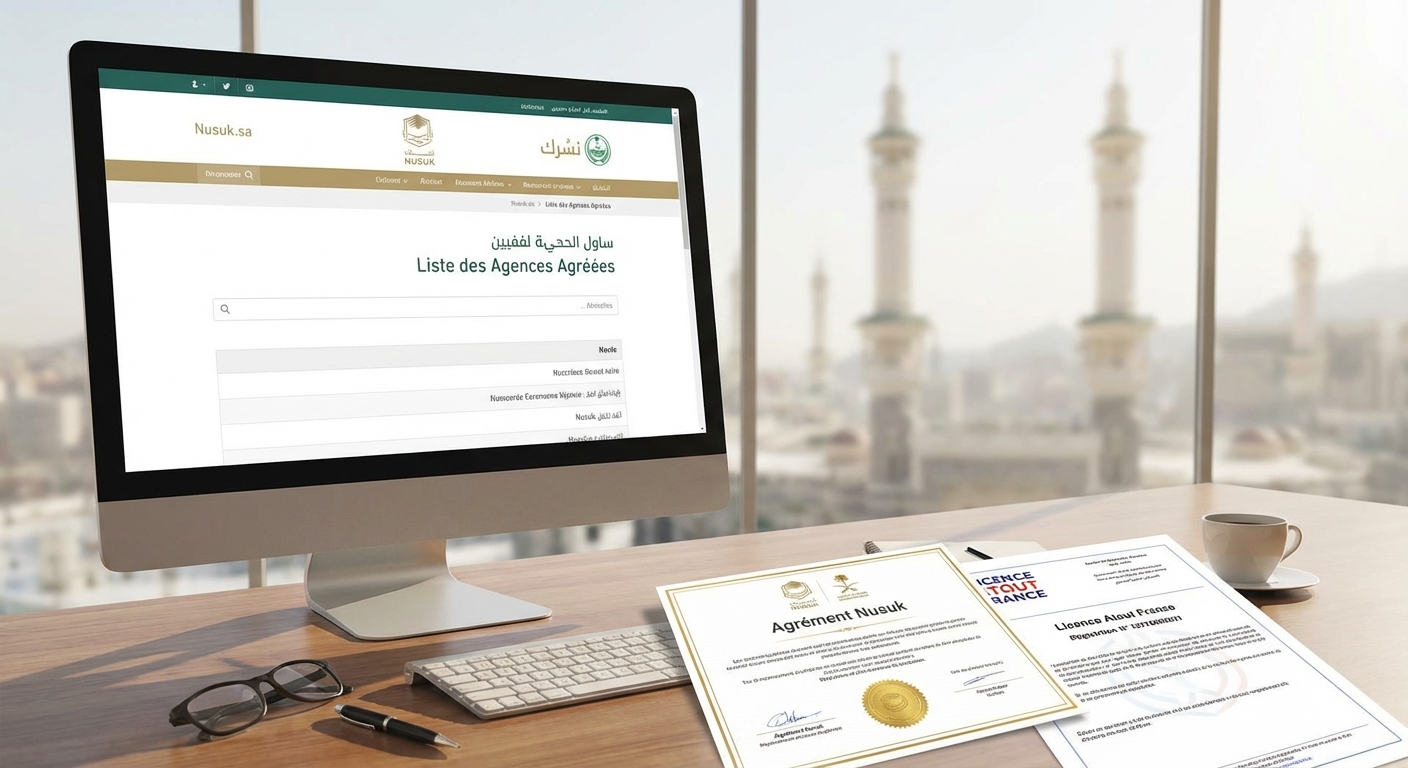
Nusuk Umrah lists Ministry-authorised service providers and allows direct bookings for eligible profiles. An overseas retailer may sell services supplied by another company. Ask who organises the journey, who operates the Saudi services and who is responsible if something goes wrong. A claimed partnership is not the same as the seller holding every licence itself.
Do not accept the blanket claim that independent Umrah is illegal. The available route depends on your visa, profile and current permissions. Equally, do not assume an agency can obtain a visa for everyone merely because it has a logo on its website.
Check the jurisdiction, not just your home address
For a UK booking sold as ATOL protected, check the named holder using the CAA search and confirm protection for your actual arrangement. An ATOL number is not a universal quality award or a guarantee for everything sold under a similar name.
In the EU, consult the relevant national authority and the applicable package-travel rules. France’s travel-operator register is a national example, not a licence every European seller must hold. Europe is not a single consumer jurisdiction.
In Canada, check the provincial system that applies: Ontario’s TICO and Consumer Protection BC are distinct registries. In the US, check applicable state requirements and the seller’s identity; do not invent a federal “Umrah agency licence”. Trade membership, a business registration and a religious endorsement each answer different questions.
Verify the details independently
Match the legal identity
Ask for the legal trading entity, registered address, business and relevant licence numbers, contact details and the name receiving payment. Search the official register yourself instead of following only a screenshot supplied by the salesperson. Similar trading names can belong to different businesses.
If a guarantee or policy is claimed, obtain the issuer, reference, validity and scope. Contact the issuer using independently obtained details where confirmation is available. Liability insurance and insolvency protection are different; neither automatically repays every failed trip.
Request the contract before paying
It should identify dates, airports, operating carriers or how these will be confirmed, hotel names, room occupancy, meals, transfers, visa services, guidance and exclusions. Ask whether quoted distances are to a usable entrance and whether an “English-speaking guide” is present throughout the trip or only for selected activities.
Read cancellation, substitution, payment and complaint terms. A brochure and a friendly voice message do not resolve an unclear contract. Reviews can highlight patterns, but neither a five-star score nor a lack of complaints proves that a booking is safe.
Recognise warning signs without inventing a price threshold
Unexplained bargains
Compare like-for-like offers for the same dates and occupancy. A low price can reflect an excluded flight, distant hotel or restrictive fare rather than fraud. There is no reliable universal rule that “30% below average” proves a scam, and a high price does not prove legitimacy.
Evasion and pressure
Stop and investigate if the seller will not identify the contracting company, explain the visa route or provide written terms. A demand to pay immediately before you can check the details is a reason to slow down. Genuine availability limits do not justify inaccurate information.
Unusual payment instructions
Be particularly cautious about payments to a personal account, gift cards, cryptocurrency or a recipient unrelated to the contract. A last-minute bank-detail change needs independent verification through a known contact. Bank transfer is traceable, but it does not necessarily offer the same recovery route as a card payment.
Use a three-stage verification process
Stage 1: establish a shortlist
Collect written offers, identify the actual businesses and read detailed recent experiences. A recommendation from a mosque, friend or relative can start the search; it cannot replace your checks. Ask the referrer which trip they actually used and when.
Stage 2: check records and services
Verify relevant registrations and claimed protection, then ask how reservations will be evidenced. If hotels or flights are confirmed, check them through the appropriate official channel using your own booking details. Do not assume a reservation reference means a ticket has been issued.
Stage 3: test the practical answers
Ask about a delayed flight, a room change, a traveller needing assistance and a missing permit. Request a realistic escalation contact. A physical office can be useful, but legitimate online businesses exist and a rented office is not a guarantee.
Keep a dated checklist of what is confirmed and what remains conditional. If a material item remains unresolved, do not treat paying the deposit as a way to find out later. Our questions before booking can help structure the conversation.
If you suspect fraud or a serious booking problem
Contact the bank or payment provider promptly through its official channel, explain what happened and ask about applicable dispute or recovery options and deadlines. Preserve the contract, receipts, transaction references, messages and advertisements. Do not send further money to an unverified recipient claiming it will unlock a refund.
Distinguish suspected fraud from a contractual disagreement, and report the facts accurately. Contact the appropriate police or fraud-reporting service and consumer regulator for your jurisdiction. US consumers can use the FTC reporting route; elsewhere use the relevant national or provincial service. A consulate is not an automatic travel-refund service.
Ask the seller and, where applicable, the organiser or protection scheme for a written response. Keep a record of the report number and next deadline. Recovery is not guaranteed, and chargeback is not a universal statutory entitlement with identical rules in every country.
Warn others responsibly using verifiable facts. Do not publish passport copies, bank details or unsupported accusations about individuals. Community support can help you organise evidence, but it does not replace official reporting or legal advice.
Make the final booking decision deliberately
Choose on the strength of documented services, workable arrangements and appropriate protections—not on a claim of being the oldest, cheapest or most religious agency. Ensure the needs of children, older relatives and disabled travellers are included in the actual contract.
Confirm the total price, currency and payment schedule. A smaller deposit may reduce the immediate amount at risk but does not make a fraudulent booking safe. Keep each receipt and check that the payment recipient still matches the verified arrangements.
Allow time to investigate before accepting non-refundable commitments. There is no magic three- or six-month booking window that prevents fraud. Before departure, recheck the reservations, current visa and access rules and official travel advice. Use our agency reliability checklist and package-price guide for the remaining practical checks.
Frequently asked questions
How do I check whether an agency is authorised?
Identify the seller and Saudi service provider separately, then verify each relevant claim in the appropriate official register. Match the legal name and payment recipient, not just the logo.
Can the price tell me whether an offer is a scam?
Not by itself. Compare equivalent services and investigate unexplained differences, missing inclusions and pressure to pay. There is no universal safe price band.
Which documents should I request?
A clear contract, the seller’s legal identity and relevant registration details, evidence of claimed protection, and a detailed itinerary with payment and cancellation terms. Requirements differ by jurisdiction.
What if I have already paid and become suspicious?
Contact your payment provider promptly, preserve evidence and seek the appropriate official reporting and consumer-help routes. Do not pay an unverified “recovery” service.
Is a mosque recommendation enough?
No. It can be useful context, but you should still check the current business, contract and protections yourself.
Can I arrange Umrah without an overseas agency?
An independent route may be available under your visa and current rules, and eligible users can book through Nusuk Umrah. Hajj has different booking and permit requirements.
How early should I book to reduce scam risk?
Allow enough time to verify the offer before paying. Booking early or late does not itself determine whether an operator is legitimate.
Sources
- Nusuk Umrah — Official platform — Direct booking and Ministry-authorised providers; availability depends on the traveller’s profile.
- UK CAA — Search ATOL holders — Verify the holder when a booking is sold as ATOL protected.
- Your Europe — Package travel — EU package-travel protections depend on the applicable arrangement and law.
- TICO — Registered Ontario travel businesses — Ontario registry; not a Canada-wide licensing scheme.
- Consumer Protection BC — Check a licence — British Columbia licence search.
- US Federal Trade Commission — Avoid travel scams — Researching offers, unsafe payment demands and reporting suspected fraud.
- GOV.UK — Pilgrimage in Saudi Arabia — UK-specific booking, documentation and fraud-prevention guidance.
FAQ
How do I check whether an agency is authorised?
Identify the seller and Saudi service provider separately, then verify each relevant claim in the appropriate official register. Match the legal name and payment recipient, not just the logo.
Can the price tell me whether an offer is a scam?
Not by itself. Compare equivalent services and investigate unexplained differences, missing inclusions and pressure to pay. There is no universal safe price band.
Which documents should I request?
A clear contract, the seller’s legal identity and relevant registration details, evidence of claimed protection, and a detailed itinerary with payment and cancellation terms. Requirements differ by jurisdiction.
What if I have already paid and become suspicious?
Contact your payment provider promptly, preserve evidence and seek the appropriate official reporting and consumer-help routes. Do not pay an unverified “recovery” service.
Is a mosque recommendation enough?
No. It can be useful context, but you should still check the current business, contract and protections yourself.
Can I arrange Umrah without an overseas agency?
An independent route may be available under your visa and current rules, and eligible users can book through Nusuk Umrah. Hajj has different booking and permit requirements.
How early should I book to reduce scam risk?
Allow enough time to verify the offer before paying. Booking early or late does not itself determine whether an operator is legitimate.