Conseils
Accessible Umrah hotels for older and disabled travellers
Almanasiq Editorial Team · Published 2026-08-22
Assess the whole accessible journey: bed, bathroom, lift, hotel exit, pavement or shuttle, and mosque entrance. If one part involves unsuitable steps, a steep slope or a long unsupported wait, an “accessible hotel” label may not meet the traveller’s needs.
Assess the whole accessible journey: bed, bathroom, lift, hotel exit, pavement or shuttle, and mosque entrance. If one part involves unsuitable steps, a steep slope or a long unsupported wait, an “accessible hotel” label may not meet the traveller’s needs.
Requirements differ for a person who walks slowly, uses a stick or walker, travels in a manual or powered wheelchair, or needs frequent rest. Describe the specific needs and equipment instead of asking only whether the property is accessible. Do not assume the label means the same features as in your home country.
The room checklist
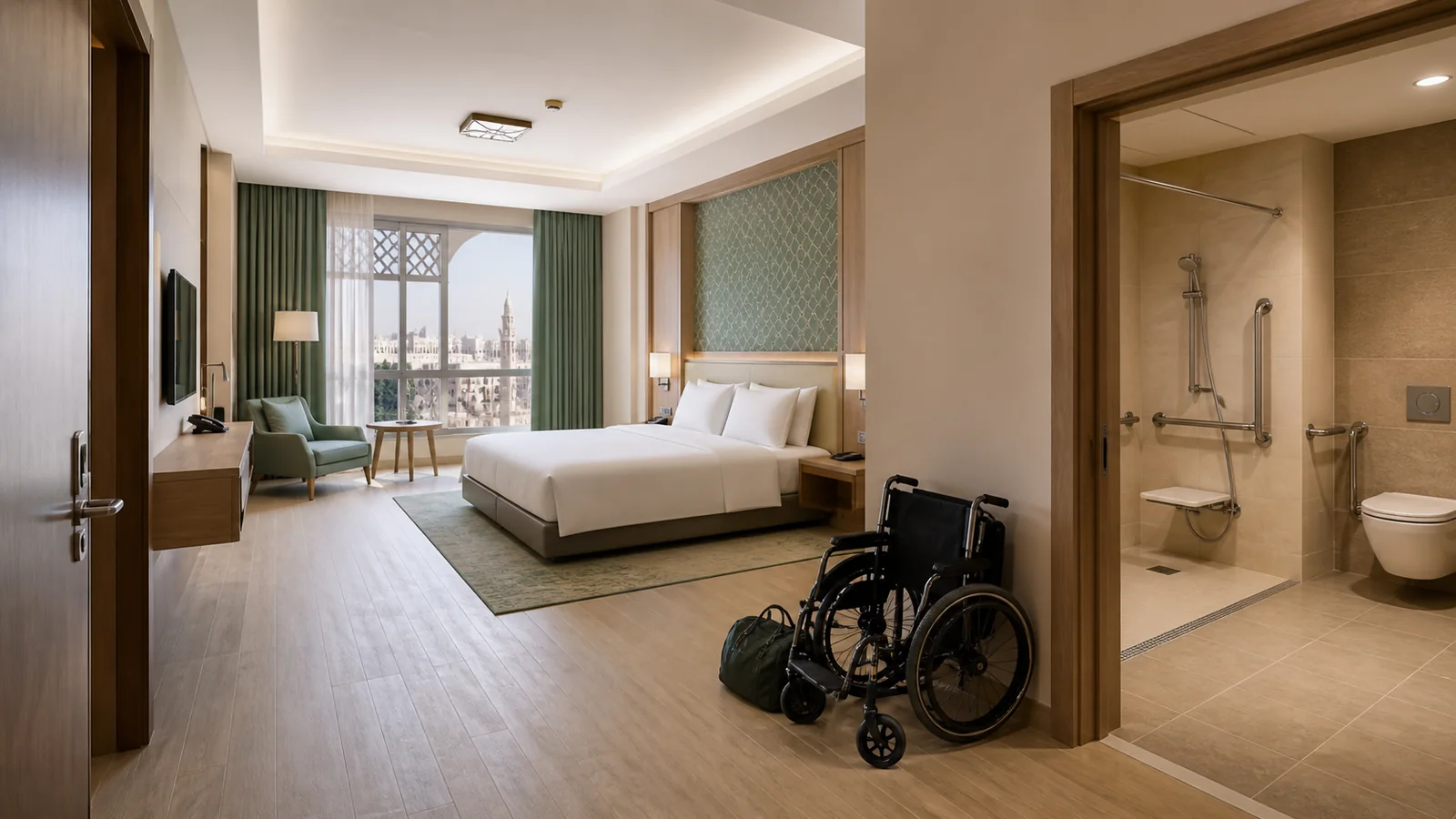
Ask for photographs, measurements or a short video of the room type that can actually be allocated, not only a generic display room. Check:
- Clear width of bedroom and bathroom doors.
- Steps, thresholds or raised shower edges.
- A level-access shower and appropriate stable seat.
- Suitable grab rails by the toilet and shower.
- Turning space for the actual wheelchair.
- Bed height and space for the traveller’s usual transfer.
- Reachable switches, sockets and telephone.
- Appropriate medication storage if required.
- Distance to lifts and possible noise.
Use a consistent unit for measurements; ask for centimetres if a description in feet or inches is unclear. Obtain written confirmation of the necessary room features on the reservation. Inspect before unpacking so any mismatch can be addressed promptly.
Lifts are part of accessibility
A building with a lift can still be difficult when large numbers of guests return after prayers. Check how many lifts serve the room, door and cabin dimensions, space for equipment and a companion, and what assistance is available during an outage.
Count every lift change between bedroom, reception, restaurant, shopping levels and street. Ask whether there is seating in waiting areas. Discuss the hotel’s evacuation arrangements for the traveller; do not assume a lift will remain available during an emergency. A compliance label does not answer these practical questions.
Check the outdoor route to the mosque
Assess lowered kerbs, pavement surfaces, crossings, gradients, automatic doors and any point where a wheelchair route becomes obstructed. Consider both directions: a manageable descent may be a difficult climb later.
The Ministry’s visitor guide maps designated mobility access, upper-level lifts and manual-wheelchair distribution points at the Grand Mosque. Follow the levels and routes currently authorised rather than trying to push through the shortest crowded route.
In Madinah, test the journey to the actual prayer area, not just the outer courtyard. Use our Makkah hotel access guide and Madinah entrance checklist to describe the full route.
Personal wheelchair, powered chair or local service
A familiar, suitably adjusted personal chair may offer advantages, but confirm how it travels. Label and photograph it, and check airline and railway handling rules before buying tickets. Request assistance through the relevant carrier’s official process rather than assuming it is included automatically.
For a borrowed chair, ask where collection takes place, identification or deposit requirements, whether it can leave the site and how it is returned. Availability should not be left to the first morning of Umrah.
For a powered chair, confirm battery type, dimensions, weight, charging and acceptance on every transport segment. A shuttle with a high step and no suitable boarding equipment is not accessible merely because a driver normally offers to lift passengers. Agree a safe arrangement suited to the traveller.
Verify shuttles and taxis
Ask whether the shuttle accepts a non-folding wheelchair, has a suitable ramp or lift, provides an appropriate space and restraint arrangement, and stops on a usable step-free route. Confirm the return timetable, booking process and contact if the vehicle is full.
For a taxi or private transfer, describe the equipment and whether the traveller can transfer to a vehicle seat. Do not assume an ordinary app category can accommodate an occupied wheelchair. Check room for bags as well as the chair, especially for airport journeys, and obtain explicit acceptance.
Plan the stay and rituals around manageable effort
Alternate activity with rest. Avoid assuming everyone can manage an overnight arrival, transfer, tawaf and sai without recovery. Keep essential medicines, prescriptions and useful medical contacts accessible, and follow individual clinical advice about exertion and hydration.
Use the authorised wheelchair routes for the rites and allow for a different or longer journey than the ground-level tawaf area. Plan who will assist and when they can rest too. Our guide to travelling with older parents covers the wider preparation.
A message to send the hotel
“We are travelling with someone using [describe the mobility aid and its dimensions]. Please confirm the room features we need in writing: step-free access, shower and seating, suitable grab rails, clear door widths, turning space and bed-transfer space. Please also confirm the route to the street, lift dimensions, any wheelchair-capable shuttle and the gradient and obstacles on the mosque route. Can you send photographs of the room type and entrance?”
Replace the bracketed description with the traveller’s actual requirements. A precise answer helps you assess suitability; reassurance without measurements should prompt further questions or a different property. Keep the reply with the booking.
Related reading: Umrah step by step: from departure to leaving ihram.
Frequently asked questions
Does an “accessible” label guarantee a suitable room?
No. It may describe only some parts of the property. Confirm the allocated room’s doors, shower, rails, turning space and bed access, together with the entire route outside.
Should we bring a personal wheelchair?
A familiar fitted chair may be preferable, but check transport and handling requirements. Official mosque guidance also describes local wheelchair services; verify availability, suitability and conditions before relying on them.
What matters most when choosing an accessible Makkah hotel?
Continuity of access. The room, lift, exit, pavement, transport and mosque entrance all need to work for the traveller. A good bathroom cannot compensate for an impassable outdoor route.
Sources
- Saudi Ministry of Hajj and Umrah — Umrah Guide for Visitors from Saudi Arabia — Ramadan 1447 guide: mosque maps, mobility facilities and practical ritual guidance. Current on-site instructions take priority.
- Visit Saudi — Haramain High Speed Railway — Railway overview and distinct airport and city stations; confirm journey details when booking.
- Saudi Ministry of Hajj and Umrah — Makkah — Official geographical and visitor information; source in Arabic.
- Visit Saudi — Madinah — Official destination overview for planning a stay.
FAQ
Does an “accessible” label guarantee a suitable room?
No. It may describe only some parts of the property. Confirm the allocated room’s doors, shower, rails, turning space and bed access, together with the entire route outside.
Should we bring a personal wheelchair?
A familiar fitted chair may be preferable, but check transport and handling requirements. Official mosque guidance also describes local wheelchair services; verify availability, suitability and conditions before relying on them.
What matters most when choosing an accessible Makkah hotel?
Continuity of access. The room, lift, exit, pavement, transport and mosque entrance all need to work for the traveller. A good bathroom cannot compensate for an impassable outdoor route.