Conseils
Getting around Makkah: buses, taxis and ride-hailing
Almanasiq Editorial Team · Published 2026-02-05
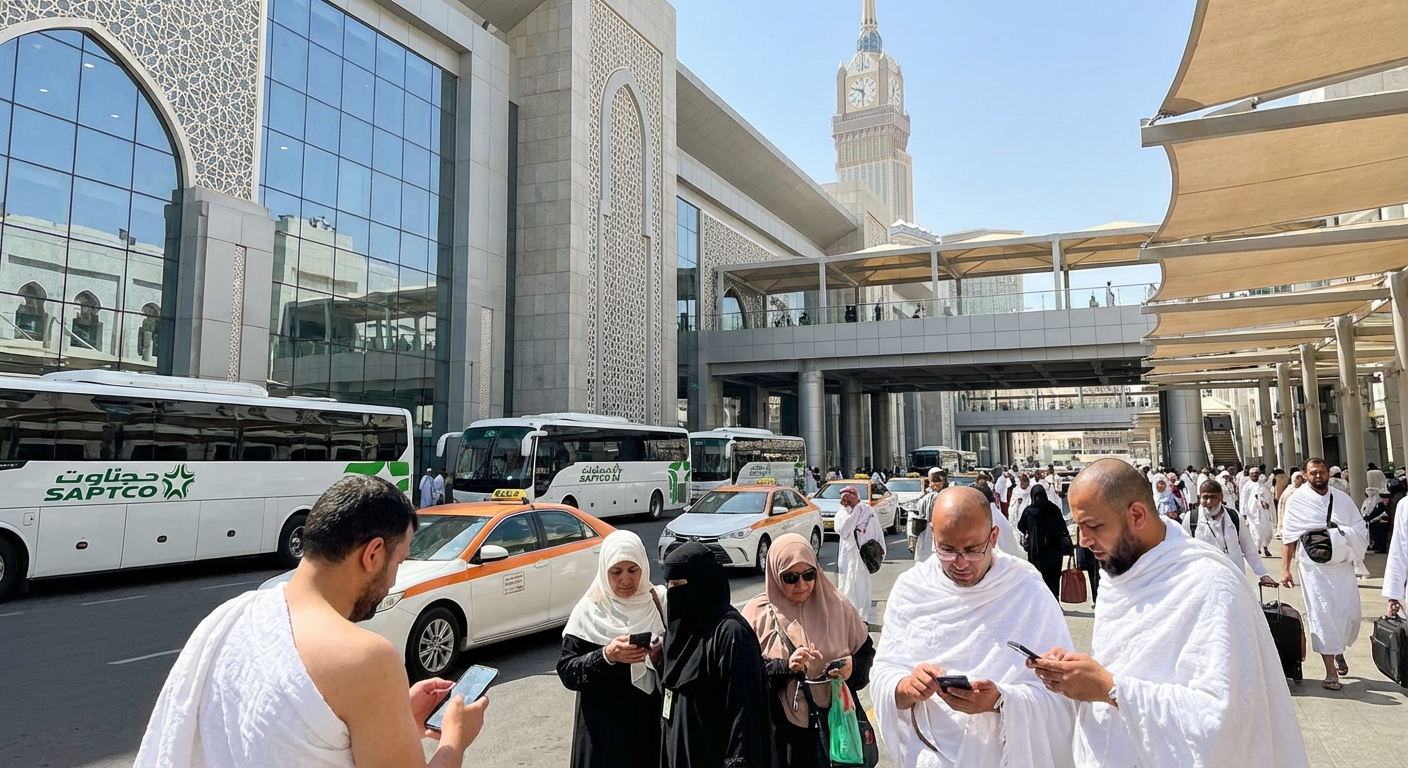
Choose transport in Makkah around your hotel, mobility needs and the current access arrangements—not a fixed journey time from an old itinerary. Public buses, licensed taxis, app-based rides and hotel shuttles serve different needs, while Hajj transport follows separate arrangements.
Choose transport in Makkah around your hotel, mobility needs and the current access arrangements—not a fixed journey time from an old itinerary. Public buses, licensed taxis, app-based rides and hotel shuttles serve different needs, while Hajj transport follows separate arrangements.
Public buses: use the Makkah network’s own information
Makkah Bus is the local service to check
For city journeys, use the Makkah Bus route planner, stops and fare information. Do not treat an old generic SAPTCO route list as the current urban network. Intercity coaches, local buses and pilgrimage transport can have different operators, tickets and pickup points.
Start with the hotel’s exact entrance and destination. Identify the nearest usable stop, direction and final service, then check how far you will walk at each end. A route reaching the central area does not promise a stop at a particular mosque gate.
Current published fares, not an unlimited day pass
The Makkah Transit fare page reviewed on 3 September 2026 lists a regular single journey at 4 SAR, four journeys within one day at 15 SAR, and sixteen journeys within one week at 58 SAR. The 15 SAR product is not an unlimited day pass. The listed 7A shuttle costs 8 SAR one way; regular-route tickets are not valid on it.
Recheck the product before buying, including validity, route and sales channel. Do not assume a bank card can always be tapped directly onboard or that every stop sells every ticket. Keep your ticket accessible and ask the service desk if validation is unclear.
Check operations on the day
Stops and routing can change with crowd management. Use current service information and posted notices; do not rely on a fixed 05:00–midnight timetable, a guaranteed short wait or old numbered routes to Mina and Arafat. For longer journeys outside Makkah, see the intercity bus guide.
Licensed taxis and shared journeys
Verify the vehicle and fare arrangement
Use a recognised taxi rank, a verified operator or your hotel’s documented booking service. Vehicle colour alone does not establish licensing. Before boarding, confirm the destination, passenger and luggage capacity, payment method and applicable meter or pre-agreed booking terms.
Ask about waiting, tolls or additional stops. Do not apply an unverified city-wide starting fare, per-kilometre rate or automatic night surcharge. Keep the receipt and enough detail to identify the ride if there is a problem.
Sharing is not the same as overloading
A shared licensed transfer can reduce the cost per person, but clarify whether the price is per passenger or vehicle and whether it depends on filling the remaining seats. Every passenger needs an appropriate seat and restraint. A nominal six-seat vehicle may not accommodate six travellers plus their large suitcases.
Do not follow a stranger to an unverified vehicle because the quote is cheaper. For a pre-booked transfer, check who is collecting you, where to meet and what happens if the flight or train is late. If the agreed pickup is inaccessible, contact the operator from a safe location rather than trying to cross a closed traffic area.
Uber, Careem and other booking apps
Check the live offer
Uber has a current Mecca service page, and Careem advertises Saudi ride services. Enter the real pickup and destination to see the options actually available to you. Prices, waiting times, vehicle categories and payment methods can vary; neither a city page nor an installed app guarantees an immediate car.
Check the pin, fare, capacity and cancellation terms before confirming. A change of destination or extra stop may affect the price. Do not assume one platform is always cheaper by a fixed percentage or that every ride is an ordinary metered taxi.
Make pickup easier
Wait at an authorised point where the driver can stop. Compare the vehicle registration and driver details with the booking, and keep the trip inside the platform. Share the ride with a trusted companion if useful. Keep your phone charged and retain access to your registered number while abroad.
For international cards, check your bank’s foreign-transaction terms and the payment methods actually displayed. If cash is selected, confirm that arrangement and have suitable notes; avoid assuming that a home-country app feature is supported locally.
Avoid unverified specialised apps
An app described in an old guide as a universal Hajj transport coordinator is not necessarily an official service. Do not upload identity documents or pay a supposed access fee merely because it uses a pilgrimage-related name. For Hajj movements, follow the platform and provider named in your confirmed arrangements.
The Mashair Train is a Hajj service
Different from Haramain intercity rail
The Mashair Train serves movements between the holy sites of the Hajj. It is not an everyday Makkah metro for an Umrah hotel commute, and it is not the Haramain train linking Makkah with Madinah and Jeddah.
The Ministry’s Hajj guidance tells travellers to check whether their package includes Mashair Train access. Do not assume the service is free and open to every visitor, or that a tourist or Umrah visa grants permission to join Hajj transport.
Follow your assigned arrangements
Confirm eligibility, credentials, station and group timetable with the Hajj provider. Follow staff instructions and the permitted movement schedule instead of improvising a route between ritual sites. An old statement about five or twelve stations, a universal interval or unrestricted 24-hour access should not determine your journey.
For a normal city-to-city journey, use the Haramain booking guide. Decide which rail service you mean before paying for a ticket or accepting a transport promise.
Hotel and agency shuttles
Ask what “shuttle included” actually means
Get the current departure point, operating hours, frequency, capacity and central-area drop-off in writing. Check the walk from that stop to the entrance you use and how to identify the return bus. “Near the Haram” and “free shuttle” do not tell you the total effort involved.
Ask whether the service continues after evening prayers, whether booking or a room key is required, and how queues are managed. A missed or full bus needs a realistic backup. Do not assume every hotel operates at half-hour intervals or gives priority to your group.
Separate included rides from excursions
Airport transfers, station transfers, ziyarat outings and daily mosque shuttles may be different services. Ask for the specific inclusions, any extra fee and the provider responsible for each. A sightseeing trip should identify the planned stops, duration, guide and return arrangements.
For accessibility, ask about steps, wheelchair storage or a lift and whether the passenger must transfer to a seat. Check those details before booking the hotel. See our hotel-shuttle checklist.
Practical planning and a transport budget
Build around actual journeys
List airport or station transfers separately from daily local trips. For each, record the full group size, bags, likely journey times and a backup. Do not assume an advertised Umrah package includes the airport transfer until the contract says so.
For local buses, multiply the fare by the number of journeys and travellers; compare any multi-journey product using its real limit. For taxis and rides, collect current quotes at relevant times. Add a reserve for a changed pickup, a missed shuttle or a necessary accessible vehicle. A fixed ten-day allowance cannot fit every hotel and family.
Walking needs a realistic route
A short map distance may involve slopes, crowds, barriers or a long approach to the usable entrance. Check the actual route and your companions’ needs; do not assume everyone can walk two kilometres comfortably or that drinking water and shade exist at fixed intervals.
Avoid making the hottest part of the day your default walking window simply because road traffic might be lighter. Take breaks and adapt the plan to conditions. Current official instructions take priority over a navigation app.
Prepare a simple fallback
Save your hotel details in Arabic and English, the operator’s contact and a meeting point for the group. Carry a charged phone and suitable payment options. If separated, use the agreed plan instead of sending family members searching in several directions. Our emergency and consular guide explains whom to contact when a routine transport issue becomes urgent.
Accessibility: confirm the entire route
Do not assume an app has wheelchair-accessible vehicles
Uber’s Mecca taxi-alternative page currently states that wheelchair-accessible vehicles are not available there. Assistance boarding a normal car is not the same as travelling while seated in a wheelchair. Verify any specialist service directly, including the chair type, dimensions, restraints and whether a transfer is required.
Do the same for buses and shuttles: a low-floor design does not establish that the needed ramp, space and accessible stop will all be usable for your departure. Avoid relying on an unverified phone number or on a promise that every mosque gate has a free wheelchair with an attendant.
Plan with the traveller, not only for them
Ask what assistance the person wants, how long they can wait and whether they can manage steps. Allocate time for boarding and identify who will carry bags. Reserve suitable transport early where available, but obtain confirmation rather than treating a request as a booking.
The hotel entrance, footpath, drop-off and final approach all matter. A more convenient hotel may reduce transfers, but proximity alone does not prove accessibility. Compare options with the accessible-hotel checklist.
Digital services and infrastructure claims
Use tools for what they actually provide
Maps, transport apps and booking confirmations can help organise the journey. They do not override road closures, permits or crowd-management instructions. Keep the essentials offline and avoid sharing sensitive documents with an unofficial service.
Distinguish Nusuk’s pilgrimage functions from the apps or tickets used by individual transport operators. There is no verified basis here for promising that one app pays for all rides, that biometric payment is mandatory or that every pilgrim can book an Arafat shuttle independently.
An announced project is not an operating route
Do not book a distant hotel on the assumption that a proposed cable car, future metro line, new bus network or augmented-reality service will be ready. Ask what is operating for your dates and look for current operator information. If a feature is not established, leave it out of the essential plan.
Ramadan and Hajj: check seasonal arrangements
Ramadan changes the pattern of demand
Prayer and meal times can create concentrated demand for shuttles and rides. Ask your hotel about its actual seasonal schedule and return pickup. Avoid turning an old published Ramadan plan into this year’s timetable; the authorities can change routes and stopping points.
A later journey may be less hot but more crowded. A car may be unable to reach the expected entrance. Allow flexibility, keep the group informed and decide when waiting is safer than changing transport in a crowded street.
Hajj has separate access controls
Verify the rules for your visa, travel dates and destinations before starting a journey towards controlled areas. A ticket, app booking or hotel reservation does not authorise entry through a checkpoint. Hajj pilgrims should follow their approved provider’s movement plan.
Before each major transfer, make a final check: valid access, confirmed service, correct pickup, suitable vehicle and working contact details. That is more useful than a promise that transport will operate “normally” throughout the pilgrimage season.
Frequently asked questions
What is the cheapest way to get around Makkah?
Walking may suit a short safe route and public buses can be economical. Compare the whole journey and your mobility needs; an unsuitable walk is not a useful saving.
Can I use Uber or Careem?
Check the live service for your pickup and destination. App availability does not guarantee a driver, a particular car type or a fixed waiting time.
How do I travel between the Hajj sites?
Use the arrangements assigned by your authorised Hajj provider. Confirm whether Mashair Train access is included; it is not an open everyday metro for Umrah visitors.
Should a taxi use a meter?
Use a licensed service and confirm the applicable regulated fare or documented booking terms before travel. Do not rely on an old fixed rate or vehicle colour alone.
Should I hire a car in Makkah?
Consider parking, access restrictions, driving eligibility and your hotel arrangements before deciding. A hired car is not automatically simpler than booked local transport.
What transport budget should I allow for ten days?
List your actual journeys and obtain current fares or quotes, then add a contingency. Separate airport and intercity transfers from local trips.
Are accessible vehicles readily available?
Do not assume so. Confirm a vehicle suitable for the individual and their equipment; a normal car with driver assistance is not equivalent to a wheelchair-accessible vehicle.
Sources
- Makkah Transit — Fares — Public transport has its own ticket conditions, distinct from private hotel shuttles.
- Pilgrim Experience Program — Makkah bus seasonal operations — Official example of season-specific operating plans; not a current route timetable.
- Uber — Mecca ride services — Current city service page; explicitly says wheelchair-accessible vehicles are not currently available.
- Careem — KSA rides — Saudi ride-hailing service; check actual local availability and vehicle capacity.
- Careem — Booking a ride — Pickup, destination, payment and estimated fare checks.
- Ministry of Hajj and Umrah — Hajj travel guide — Check whether Mashair Train access is included in your Hajj package.
- Haramain High Speed Railway — Booking and timetable — Official journey search, passenger selection and assistance options.
- Saudi Ministry of Health — Pilgrims’ health — Find the current and distinct Hajj and Umrah health documents.
FAQ
What is the cheapest way to get around Makkah?
Walking may suit a short safe route and public buses can be economical. Compare the whole journey and your mobility needs; an unsuitable walk is not a useful saving.
Can I use Uber or Careem?
Check the live service for your pickup and destination. App availability does not guarantee a driver, a particular car type or a fixed waiting time.
How do I travel between the Hajj sites?
Use the arrangements assigned by your authorised Hajj provider. Confirm whether Mashair Train access is included; it is not an open everyday metro for Umrah visitors.
Should a taxi use a meter?
Use a licensed service and confirm the applicable regulated fare or documented booking terms before travel. Do not rely on an old fixed rate or vehicle colour alone.
Should I hire a car in Makkah?
Consider parking, access restrictions, driving eligibility and your hotel arrangements before deciding. A hired car is not automatically simpler than booked local transport.
What transport budget should I allow for ten days?
List your actual journeys and obtain current fares or quotes, then add a contingency. Separate airport and intercity transfers from local trips.
Are accessible vehicles readily available?
Do not assume so. Confirm a vehicle suitable for the individual and their equipment; a normal car with driver assistance is not equivalent to a wheelchair-accessible vehicle.