Advice
Nusuk Hajj 2027: registration, package prices and dates
Almanasiq Editorial Team · Published 2026-02-03 · Updated 2026-10-26 · Sources checked on 26 October 2026
Pilgrims from Europe, North America and other countries without an official Hajj mission book Hajj on the official Nusuk Hajj platform. As of 26 October 2026, the 1448 AH / 2027 season is not open yet. Last year, accounts opened on 7 October and packages went on sale on 1 February. Here is the expected timeline, 2026 prices, package types and the 10 registration steps.
Nusuk Hajj 2027: registration, package prices and dates
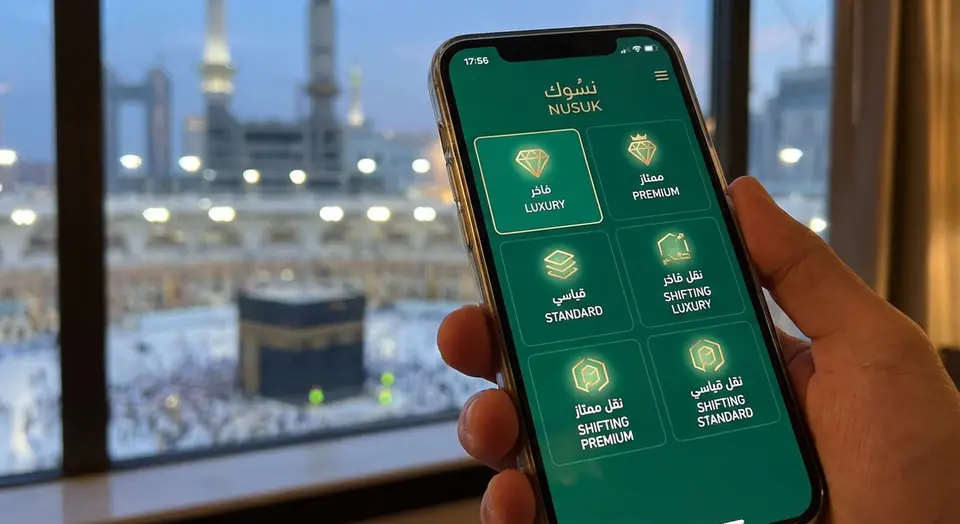
At a glance (updated 17 November 2026): pilgrims from Europe, North America, Australia and other countries without an official Hajj mission book Hajj directly on the official Nusuk Hajj platform (hajj.nusuk.sa). The 1448 AH / 2027 season is not open yet: the site still shows the 1447 season. Last year, account registration opened on 7 October 2025 and package sales on 1 February 2026. Hajj 2027 is expected around 14–19 May 2027. Expect roughly SAR 32,000–35,000 (≈ $8,500–$9,300) per person before flights for a Premium or Luxury package in a quad room, based on 2026 prices published by agencies.
Who has to use Nusuk Hajj?
Nusuk Hajj is the Saudi Ministry of Hajj's direct programme for pilgrims from countries without an official Hajj mission, including most of Europe, North America and Australia. Pilgrims living in the UK, France and other European countries have used it for recent seasons.
The list of serviced countries is set every year (the Serviced Countries page on the platform). Check it for the 1448 season as soon as it is published, looking at both your nationality and your country of residence.
A tourist visa, an Umrah visa or a Rawdah appointment does not allow you to perform Hajj. You need an official Hajj package and permit.
Expected timeline for Hajj 2027
| Stage | 2026 season (1447 AH) | 2027 season (1448 AH) |
|---|---|---|
| Account registration opens | 7 October 2025 | not announced yet (as of 17 November 2026) |
| Package sales | 1 February 2026 | expected early 2027 |
| Days of Hajj | late May 2026 | expected around 14–19 May 2027 (depending on the lunar calendar) |
The 2027 dates are not official until Nusuk publishes them. Sign up for the hajj.nusuk.sa newsletter to be notified when registration opens.
How much does a Nusuk Hajj package cost?
Nusuk does not publish a fixed price list: each package has its own price, depending on the category, length of stay, room type and distance from the Haram. Orders of magnitude for the 2026 season:
| What is counted | 2026 order of magnitude | Source |
|---|---|---|
| Premium or Luxury land package, quad room, without flights | SAR 31,900–34,700 (≈ $8,500–$9,250) per person | 2026 Nusuk prices published by an agency |
| Total budget from Europe with flights | from about €8,000, often €10,000–€15,000 | agency and comparison-site estimates |
| Extra costs | flights if not included, meals outside the package, vaccines, insurance, tips | — |
These amounts are indicative: the real price is the one shown in your Nusuk account at booking. Be wary of any "Hajj 2027 package" sold before the season officially opens.
Package types
According to the official platform:
| Type | What is included | Minimum stay |
|---|---|---|
| All-Inclusive | visa, flights, accommodation, meals, transport, Mashair services (Mina, Arafat, Muzdalifah) and guidance | — |
| Shifting | accommodation near the Mashair during Hajj, plus a Makkah hotel before or after | 14 days |
| Non-Shifting | a single Makkah accommodation for the whole stay | 10 days |
| Mashair only | the days of Hajj only | 6 days |
Hotels are classed as 5-star, 4-star and 3-star or residential. The Luxury, Premium and Standard categories mainly reflect hotel quality and the location of the tents in Mina.
Registration in 10 steps
The official platform describes this process:
- Set up an account
- Submit your documents (passport, photo)
- Complete the application form
- Wait for application verification
- Choose a category
- Add funds to your eWallet
- Browse service providers
- Select a package
- Book the package
- Review your itinerary
⚠️ Creating an account does not guarantee a place. The platform states that registering does not mean you are accepted for Hajj. Packages sell quickly when sales open: prepare your documents and budget in advance.
Prepare your file now
- a passport valid long enough after Hajj (check the period required for the season);
- a photo that meets the guidelines shown when you upload it;
- your contact details and proof of residence;
- a bank card with a high enough limit to fund the eWallet, and the ability to receive the verification code;
- the vaccines required for Hajj (meningococcal ACYW vaccination was mandatory in 2026). Check the official health document for the 1448 season; it is different from the Umrah one.
Enter your details exactly as in your passport. A mismatch in your name or date of birth can block the visa.
Cancellation and refunds
Terms depend on the package and the season. Read them before paying, save a dated screenshot, and check separately what happens to the package, flight, visa and insurance if you cancel. Always use the official channel linked to your booking.
Avoid scams
- Open hajj.nusuk.sa yourself in the browser rather than through a link sent by message.
- Nobody can guarantee you a quota or "priority access" for a fee.
- Never share your OTP code or Nusuk login details.
- Never pay for a Hajj package by bank transfer to an individual.
- Check that any travel company you deal with is properly licensed in your country, and check the provider shown in Nusuk. For Umrah, compare agencies in our Umrah agency directory.
Sources
- Nusuk Hajj, official platform (steps, package types, serviced countries)
- Saudi Ministry of Hajj and Umrah
- Saudi Ministry of Health, pilgrims' health
- 2026 timeline and 2027 season status: Wego, Hajj registration status (checked 26 October 2026)
- 2026 Nusuk prices by category: Hisar Tour, Nusuk Hajj packages; European budgets: Wego, Hajj cost by country
Understand which Nusuk service you need
Hajj is not Umrah
The official Nusuk Hajj platform offers packages under the Direct Hajj programme for serviced countries. Its public information explains that the target countries are determined for each year. Do not generalise this route to every international pilgrim or assume that nationality and residence are interchangeable.
Travellers living in Europe, the UK, Canada or the US should check the current serviced-country information and enter their actual profile. Where your country is outside the programme, follow the official route for it instead of choosing a false residence to unlock the form.
Nusuk Umrah concerns Umrah services. The Nusuk app also supports relevant permits and appointments, but an app account or a Rawdah booking is not a Hajj place. A tourist or ordinary Umrah visa does not authorise Hajj. The UK pilgrimage guidance directs Hajj bookings through Nusuk Hajj for its audience.
What registration does and does not do
Creating an account begins a process; the platform explicitly states that it does not mean acceptance for Hajj. Verification, available packages, booking and the required final documents are distinct stages. Do not pay an intermediary who claims they can turn a pending account into a guaranteed allocation outside the official process.
Official provider listing gives you a verifiable booking channel. It does not remove the need to read the package, disclose relevant needs and retain evidence of what was purchased. A digital platform cannot guarantee that every practical aspect of a large journey will be problem-free.
Work through the ten preparation stages
The following stages follow the public Nusuk Hajj outline. The screens and requirements can change by season and profile; this is a preparation guide, not a claim that every user sees identical fields.
1. Create your account
Use the official site and an email address and phone number you control. Enter the correct country and passport details, then complete the verification requested. Keep a secure record of the account reference and access method. Do not share your password or OTP with an unofficial helper.
For relatives who need assistance, use the platform’s permitted family or support arrangements. Help them understand and check the information rather than silently submitting guesses. A name on a social-media group is not an authorised support channel.
2. Prepare and upload the requested documents
Follow the file type, size, image and validity instructions actually shown. Use a clear, complete passport-page image and the photo and residence evidence required for your profile. Do not assume that an old 800 × 400 or 200 × 200 specification is current, or that every applicant can use a driving licence as proof of a year’s residence.
Review readability before submission. Avoid cutting off document edges or altering identity information to fit a template. Protect files containing passports and health information; do not upload them to an unknown image-resizing service.
3. Complete the application
Check names, dates, passport numbers, contact information and any residence or family details against the supporting evidence. Date formats can differ between a US document, a European form and the platform; read the field labels carefully.
Answer relevant health and accessibility questions accurately. Ask support if a required field does not fit your circumstances. Do not invent a flight number, translate a passport name into a new spelling or enter an address where you do not live to make the form pass.
4. Follow application verification
Check the status in the account and any requested corrections. Retain the notification and reference number. Approval of identity details is not the same as confirmation of a purchased package.
Do not rely on a guaranteed two- or three-week review period. If a status is unclear or a deadline is approaching, contact the official service with the relevant evidence. Creating duplicate applications can complicate the issue rather than accelerate it.
5. Select the category you can actually use
Read the accommodation and duration description rather than choosing by a luxury label alone. Room occupancy, location and accessibility can have more practical effect than a star rating. Distinguish the Makkah hotel from accommodation and services during the ritual days.
The current public site describes shifting as a change between a Makkah hotel and accommodation nearer the Mashair during the Hajj period; non-shifting keeps one Makkah accommodation arrangement. Do not interpret shifting as necessarily moving to a lower-star hotel or as proof of an inferior package. Confirm the full itinerary and baggage arrangements.
6. Review the payment or wallet instructions
The public journey includes topping up an e-wallet. Before moving money, read the current options, fees, currency, processing time and withdrawal terms shown for your account. The general terms also mention card payments; do not assume an old blog’s payment-method list is exhaustive.
Ask your bank about international payment limits and charges through its official channel. A permitted top-up does not reserve a package. Keep enough funds outside the platform for household needs and contingencies. Do not send money to an IBAN copied from a chat message or an alleged cash collection centre that you have not verified through the platform.
7. Compare service providers
Use the providers presented through the official platform and compare the actual packages, language support, room arrangements and services. Obtain clarity on essential assistance or health-related needs before purchase.
A recommendation from someone who travelled in a previous year can provide context, but it cannot confirm this season’s staff, itinerary or contract. Ask which company will handle problems at each stage and how to reach it during the trip.
8. Compare complete packages
Record hotels, room occupancy, number of nights, meals, transport, Mashair arrangements, guidance, flights where included and exclusions. The site’s all-inclusive description includes flights, but the specific offer and its flight-selection conditions determine your booking. Do not automatically assume all international flights are excluded or all flight types have identical refund rules.
Check the departure airport, baggage and transfer sequence. Travellers from North America should include any positioning flight or overnight connection in the comparison. For European and UK departures, an alternative airport may add substantial transport and hotel costs.
Save more than one acceptable option if the platform allows. Choose alternatives you would genuinely use, not a list of unavailable “dream packages” that encourages panic buying later.
9. Book through the official process
Follow the announced procedure for the correct season and account category. Do not assume a previous year’s release time, first-come allocation rule or quota applies unchanged. A successful top-up, a pending bank charge and a completed booking are different events.
Before confirming, review names, travellers, package details, total price and the cancellation terms. After payment, save the official booking confirmation. If the result is uncertain, check the account and contact support before repeating a large payment.
10. Review the final itinerary and permissions
Reconcile the booking against the final documents: travel dates, flights, accommodation, transfer instructions, group contacts and any required Hajj visa or permit. Report discrepancies through the official channel promptly.
Keep secure paper and offline copies and share appropriate emergency details with a trusted contact. Do not publish documents containing QR codes or identity data in a public group. A complete itinerary is useful only if all travellers know the meeting points and how to obtain help.
Build a budget for your country and package
Compare like-for-like totals
Country-specific price ranges from a previous season are not current offers. Obtain the price attached to an available package and identify the currency clearly.
For a UK household, budget in GBP; in euro-area countries use EUR where relevant; distinguish CAD from USD in North American comparisons. Include the payment provider’s conversion rate and fees when the package is charged in another currency. An unlabeled dollar sign is not a useful comparison.
Identify what the price covers
Use a worksheet with separate rows for the package, flights not included, baggage, travel to the departure airport, insurance, medical preparation, personal spending and a contingency. Confirm whether meals cover every day and whether transport includes all relevant segments.
Room sharing can affect the price and the daily experience. Check actual beds, bathroom arrangements and whether companions remain together. A lower price is not worthwhile if the accommodation or assistance cannot meet a traveller’s needs.
Check when funds become committed
Separate the amount in a wallet from the amount spent on a confirmed booking. Record fees for topping up, paying, cancelling and withdrawing where applicable. Do not assume a fixed card surcharge or instant transfer completion; your bank and the platform may each have their own conditions.
Avoid financing the journey with money needed for existing obligations or assuming a refund will arrive in time to pay another bill. If no suitable package is available within your limit, stop rather than purchase a product you cannot safely use.
Use the correct season and official dates
Hajj 1447 is a past campaign
At the 3 September 2026 review date, the 2026 Hajj season has already taken place. An old October registration date or February booking launch is not a future appointment. Public pages may continue to display 1447 material; check the season before interpreting a registration button as an open sales window.
Do not carry forward projected dates, conflicting March or April refund deadlines, or an old quota announcement into the next season. Subscribe to official updates and retain the announcement relevant to your application.
Separate the deadlines
Track account verification, package release, payment, cancellation, visa issuance, final entry and departure as distinct dates. One may change without the others moving. Write the source and the time zone next to each deadline.
Saudi Arabia uses UTC+3. Your local offset can change with daylight saving time in parts of Europe and North America. Convert the actual announced date with a reliable calendar instead of copying a previous season’s “7 am” or “noon” conversion.
Plan around uncertainty
Do not book separate non-refundable flights solely because you have created an account. Check how the official package handles arrival and departure before arranging extras. If you must make an early commitment, understand the risk and cancellation conditions rather than assuming a place will be allocated.
Check the Hajj health requirements, not an Umrah summary
What the 2026 document says
The official Hajj 1447 document includes fitness conditions as well as vaccination rules. It requires an appropriate ACYW-containing meningococcal vaccine, at least ten days before arrival, with validity depending on the vaccine type. COVID-19 evidence applies to specified groups; it is not described as a universal rule for everyone aged twelve and over. Polio and yellow-fever requirements depend on the listed countries and circumstances.
For a future Hajj, obtain that season’s document from the Ministry of Health. Do not substitute the separate Umrah PDF or an old list of vaccine brands. A clinician should assess the current requirements against the traveller’s history and medical needs.
Start health preparation before payment
Discuss relevant chronic illness, pregnancy, mobility and treatment needs before buying an inflexible package. Some official fitness conditions are more than a recommendation to have a consultation. Do not assume oxygen, dialysis or another service can simply be arranged after arrival.
Prepare permitted medicines and documentation in advance, and confirm the rules for medical devices and batteries with the airline and provider. Controlled medicines can have a separate SFDA clearance process. A general letter is not guaranteed to settle every requirement.
Insurance and support
Ask whether the insurance actually covers Hajj, the itinerary, declared conditions, emergencies and repatriation. A visa-related medical policy is not necessarily a complete travel policy. Confirm exclusions involving known events, security advice or disruption, and retain the assistance number separately from your phone.
Read cancellation, refund and withdrawal terms before paying
Verified general terms versus an individual entitlement
The public terms checked on 3 September 2026 describe a grace period of 72 hours after purchase or until bookings close, whichever comes first. They also describe refund processing of up to 45 working days and a 2% fee, excluding tax, for wallet refunds. Flight-booking conditions apply separately.
The wording mentions refunds to the wallet and return to the same card for Visa or Mastercard payments. Ask support to confirm how your payment will be handled. These general statements do not establish an automatic 100%, 95% or zero-refund result for every package, reason and date.
Save the terms attached to your purchase
Keep the package cancellation policy, flight terms, payment receipt and the relevant dated conditions. If wording conflicts, ask for clarification before committing. A medical emergency or other serious event should be reported with appropriate evidence; do not assume either a guaranteed exception or that no legal remedy can ever exist.
Cancellation and wallet withdrawal are different
Cancelling a booking changes the travel reservation. Requesting withdrawal concerns available funds. Check the status and consequences of each action before confirming it. Do not assume money subject to one request is immediately available for a replacement package.
If a refund is delayed, record the request reference, date, amount, currency and destination account or card, and follow the official complaint route. Your home bank may also need a transaction reference. Avoid paying a third party to “release” a refund or handing them account access.
Resolve technical problems without creating new ones
Login and verification codes
A login failure can have several causes: incorrect details, an account issue or a service problem. It is not proof that the server is overloaded. Check the address, keyboard settings and registered email, then use the official recovery route if needed. Avoid repeated guesses and never share a verification code with an unsolicited caller.
If an OTP does not arrive, check the relevant inbox or phone details and the service’s retry instructions. Do not assume changing Wi-Fi will resolve a message-delivery problem. Retain the account reference without exposing private documents in public discussions.
Payments and missing balances
If a card is declined, ask the issuer about limits, authentication, billing details and whether a charge is pending. A decline is not always an anti-fraud block. Do not ask a bank to disable safeguards generally or promise that “whitelisting the ministry” will fix every payment.
If your bank shows a charge but the platform does not show the expected result, retain the timestamp and reference and contact official support. Check before retrying. No universal two-hour wait or four-hour escalation threshold is established here.
Documents and prolonged review
Read the exact correction request. Upload a clearer document only through the official account and keep a record of the submission. Ask what is outstanding when a status remains unclear. A generic “verified” message should not be interpreted as a booking confirmation.
Official support channels
The help page lists live chat, email assistance and a call centre at +966 9200 31201, with the call centre advertised as available 24/7 at this review. The official UK pilgrimage page also lists Support@hajj.nusuk.sa. Recheck these on the official help page before sending sensitive information. Published response targets are not a guarantee that your case will be resolved immediately.
Contact Nusuk for platform and package issues, a qualified teacher for religious questions, and the appropriate emergency or consular service for those matters. They are different services.
Prepare carefully without believing in a guaranteed quota strategy
Create an accurate application when the relevant season’s official process permits it, identify suitable packages and resolve essential health or accessibility questions early. Preparation reduces avoidable errors; it does not guarantee an allocation.
Keep several acceptable options within a firm budget. Check your payment method and allow for the actual transfer process, but do not move money prematurely on the strength of an unofficial countdown. Do not buy access to a supposed faster queue, use a false residence or trust an agent claiming a secret quota.
Use a reliable device and connection you understand. This guide does not claim a desktop computer always wins over a phone, or that logging in exactly thirty minutes early secures a place. Follow the platform’s rules and do not automate purchases or repeatedly submit payment requests.
Review current security advice before new commitments. At this September 2026 check, Canada advises avoiding non-essential travel to Saudi Arabia and the US advises reconsidering travel; UK advice includes regional restrictions and disruption warnings. Read the current advice from your own government and the effect on your insurance, not just an old Hajj checklist.
If this year’s plan cannot be completed, preserve your records, check any funds and unresolved requests, and wait for verified future instructions. Hajj preparation should remain an informed decision, not a race driven by fear of missing out. For an Umrah journey instead, see our complete Umrah guide and Nusuk and Rawdah guide.
Sources
- Nusuk Hajj — Official platform — Direct Hajj programme for serviced countries, ten preparation stages and package descriptions; checked 3 September 2026.
- Nusuk Hajj — Serviced countries — Check the current programme list and your eligibility; do not assume coverage of every country.
- Nusuk Hajj — Terms of use — General payment and cancellation terms; individual booking and flight conditions also apply.
- Nusuk Hajj — Help and support — Official assistance channels and published service availability.
- GOV.UK — Pilgrimage in Saudi Arabia — UK-specific booking, documentation and fraud-prevention guidance.
- Saudi Ministry of Health — Hajj requirements 1447H (2026) — Hajj fitness, vaccines and other health conditions. This document is not a substitute for the next season’s requirements.
- Saudi Ministry of Health — Pilgrims’ health — Find the current and distinct Hajj and Umrah health documents.
- SFDA — Controlled-drug clearance for travellers — Official personal permit process through the Controlled Drugs System.
- GOV.UK — Saudi Arabia travel advice — Recheck current security warnings and their effect on travel and insurance.
- Government of Canada — Saudi Arabia travel advice — Current destination advice for Canadian travellers.
- US Department of State — Saudi Arabia travel advisory — Current destination advice for US travellers.
FAQ
When does Nusuk Hajj 2027 registration open?
As of 26 October 2026, the date has not been announced and the platform still shows the 1447 season. Last year, account registration opened on 7 October 2025 and package sales on 1 February 2026.
How much does a Nusuk Hajj package cost?
There is no single price. In 2026, Premium or Luxury land packages in a quad room were around SAR 32,000–35,000 (about $8,500–$9,300) per person, before flights. With flights from Europe, budgets start around €8,000 and often exceed €10,000.
What are the dates of Hajj 2027?
Hajj 1448 is expected around 14–19 May 2027, with the Day of Arafah around 15 May, depending on the sighting of the moon.
Who has to book Hajj through Nusuk?
Pilgrims from countries without an official Hajj mission, including most of Europe, North America and Australia, book directly on Nusuk Hajj. The list of serviced countries is confirmed each season on the platform.
Does creating a Nusuk account guarantee a Hajj place?
No. The platform states that registering does not mean acceptance. A place is only secured once a package has been booked and paid under the season's conditions.
What is the difference between Shifting and Non-Shifting packages?
A Shifting package includes accommodation near the Mashair during Hajj and a Makkah hotel before or after (14 days minimum). A Non-Shifting package includes a single Makkah accommodation for the whole stay (10 days minimum).