Conseils
Ten tawaf mistakes to avoid during Umrah
Almanasiq Editorial Team · Published 2026-02-05
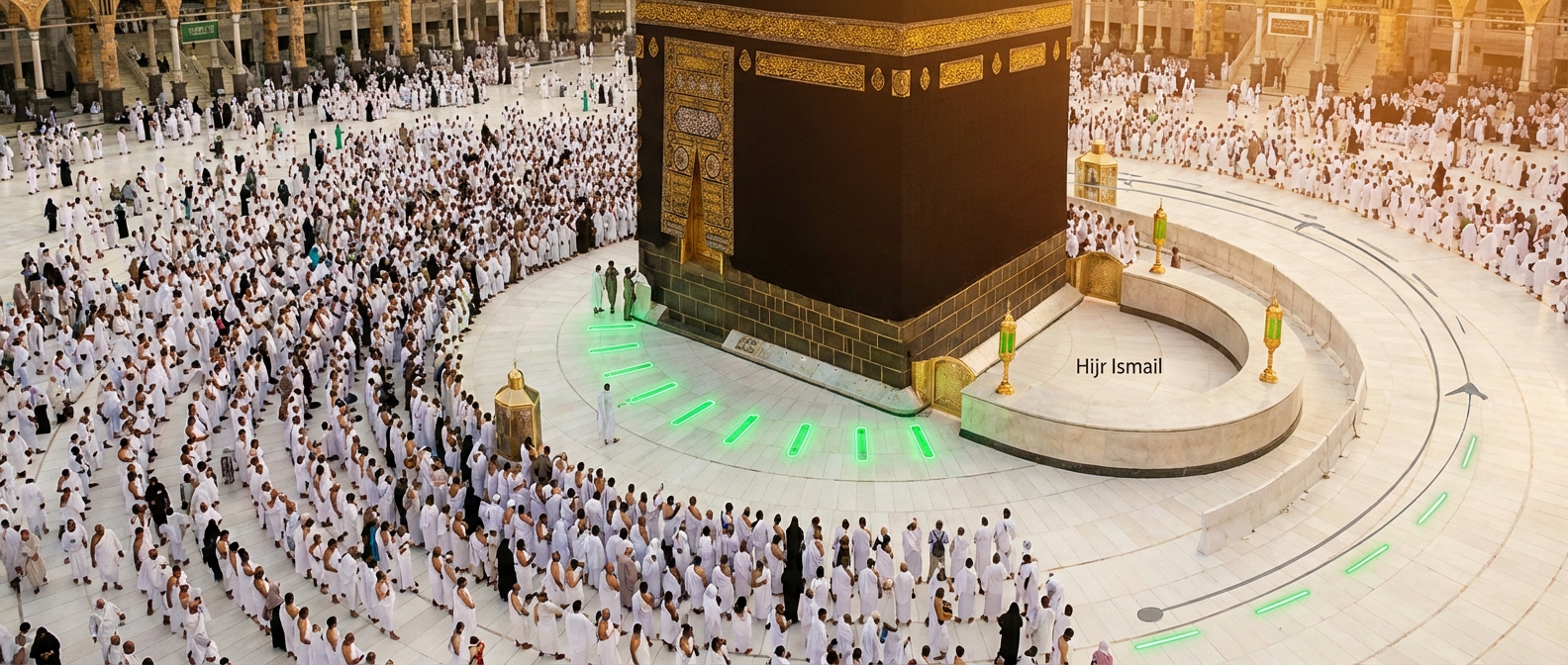
Prepare the essentials before entering the tawaf area: the correct starting point, seven complete circuits with the Kaaba on your left, a route outside the Hijr, and consideration for other pilgrims. Some detailed rulings differ between schools. This guide helps you recognise common problems without declaring every omission to invalidate your Umrah.
Prepare the essentials before entering the tawaf area: the correct starting point, seven complete circuits with the Kaaba on your left, a route outside the Hijr, and consideration for other pilgrims. Some detailed rulings differ between schools. This guide helps you recognise common problems without declaring every omission to invalidate your Umrah.
1. Starting without checking ritual purity
Prepare your wudu before tawaf and learn the guidance you follow. Scholars differ on the precise legal status of purity and on what follows if it is lost. It is inaccurate to claim that every school gives an identical ruling.
If you know your wudu has broken, leave the crowd safely and seek the appropriate guidance about purification and resumption. Mere intrusive doubt is not the same as knowing something happened; do not repeatedly restart on speculation. A persistent medical condition should be discussed with a qualified teacher before travel.
For an interruption, note the circuits you are certain of. The reason, length of the break and school followed can affect what to do next. Do not assume every toilet break is handled by a universal “resume at the exact point” rule.
2. Misidentifying the starting point
Each circuit runs from the alignment of the Black Stone back to that alignment. Identify the current signs before beginning and ask staff if you are unsure. You do not have to reach or touch the Stone to start.
Do not depend on an old video showing a painted line that may not be present. Avoid stopping abruptly or pushing across the flow to obtain a supposedly perfect photograph of your position. Allow enough space to follow the route calmly, including on an authorised upper level.
3. Treating intention as a compulsory spoken script
Know that you are performing the tawaf of your Umrah. Intention is not a performance for the group, and no special English or Arabic sentence needs to be shouted before the first circuit.
Learn the distinction between intending the Umrah at the miqat and recognising the rite you are now doing. Do not infer that a pilgrim without a memorised verbal formula has no intention. Ask a teacher about detailed legal questions rather than treating a checklist as a ruling on someone else’s worship.
4. Taking a shortcut through the flow
Keep the Kaaba on your left and follow the counter-clockwise circuit. Do not reverse direction, cross the crowd to shorten the route or treat moving between people as a race.
Follow the authorised route and current instructions for your level. An outer circuit can be longer but may suit you better than trying to remain close to the building. Choose safety over a particular distance from the Kaaba and agree a meeting point if companions become separated.
5. Losing track of the seven circuits
Count after returning to the starting alignment: that completes one circuit. Use your fingers or a simple counter if helpful, and agree with a companion how to compare counts without arguing in the crowd.
If genuinely unsure between two counts during tawaf, seek the guidance you follow; a common approach is to proceed from the lower number you are certain of. Repeated doubts after completion need their own guidance and should not trigger endless repetition.
A phone’s location estimate is not a religious certification of completed circuits. This guide does not claim that Nusuk automatically counts your tawaf accurately with GPS.
6. Pushing to reach the Black Stone
Touching or kissing the Stone is not a condition for completing tawaf. Sahih al-Bukhari 1613 records pointing towards the corner and saying takbir. If access would harm or obstruct someone, continue on your route and follow the appropriate gesture from a safe position.
Do not create a stationary line in the moving crowd or pull another pilgrim aside. At the Yemeni Corner, do not invent the same pointing ritual if you cannot reach it; learn the distinct guidance for each location. Avoid declaring that one mistake automatically erases every reward—your task is to avoid harm and correct your conduct.
7. Passing inside the Hijr
The low curved wall beside the Kaaba marks an area you must go around, not cut through, during tawaf. Stay outside the whole Hijr enclosure so your circuit goes around the House.
Entering that area at another appropriate time is not a shortcut during the circuit. If you realise you crossed through it, ask qualified guidance about correcting the affected circuit rather than ignoring the problem or declaring the whole journey invalid yourself.
8. Praying where you obstruct the route
After tawaf, perform the two units of prayer according to the guidance you follow. The prophetic account associates them with Maqam Ibrahim, but do not block the tawaf flow to insist on praying immediately behind it. Use a suitable permitted place where you will not harm others.
The detailed legal classification differs between schools, so avoid claiming a unanimous or majority obligation without qualification. Cover the shoulders appropriately for prayer. Al-Kafirun and Al-Ikhlas are associated with these two units in the transmitted account; they are not permission to rush the prayer or obstruct an exit.
9. Confusing raml and idtiba
For men in the relevant Umrah tawaf, raml is the recommended brisk, short-stepped pace of the first three circuits when it can be done without harm. Walk normally for the remaining four. Women are not asked to perform this practice.
Idtiba is arranging the upper wrap under the right arm and over the left shoulder during this tawaf. It is not limited to the first three circuits and is not a rule to keep the shoulder exposed throughout the journey. Cover up again for the prayer after tawaf.
Do not push to perform raml, and do not treat omitting a recommended practice as automatically invalidating the rite. The tawaf of Umrah should not simply be relabelled as the separate arrival tawaf of every form of Hajj.
10. Letting a script or phone distract from the rite
No compulsory supplication is assigned to each of the seven circuits. You may make personal requests and remembrance while remaining aware of people around you. Between the Yemeni Corner and the Black Stone, the supplication in Abu Dawud 1892 asks for good in this life and the next and protection from the Fire.
Keep your voice considerate, and avoid filming strangers or looking down at a screen while moving. A brief necessary conversation is not the same as treating tawaf as a social outing. Read our supplication guide before entering the crowd.
If prayer, illness or an emergency interrupts the rite, give safety its proper priority and obtain guidance about resumption. The step-by-step Umrah guide places tawaf in the wider sequence.
Frequently asked questions
What if I lose count?
Keep the number you are certain of and ask about genuine uncertainty under the guidance you follow. Do not let recurring doubts after completion lead to endless repetition.
Can I use a wheelchair?
Assistance can be appropriate. Confirm the authorised route, service arrangements and any relevant religious guidance; an upper-level circuit may take longer.
Must I touch the Black Stone or Yemeni Corner?
No. Do not harm people to reach either corner. The guidance about pointing at the Black Stone is not an instruction to point at every corner.
How long does tawaf take?
It depends on the level, route, crowd and your pace or assistance needs. There is no fixed three-kilometre distance or guaranteed completion time.
Is there a required dua for each circuit?
No compulsory circuit-by-circuit script is prescribed. Learn the transmitted remembrances and make appropriate personal supplications without disturbing others.
Can I resume after going to the toilet?
The answer depends on the interruption and the religious guidance followed. Re-establish purity as required and ask how to resume; this is not an identical rule in every school.
Are all types of tawaf the same?
Their purposes and some associated rulings differ. The tawaf of Umrah is part of Umrah; Hajj also has arrival, ifadah and farewell contexts that should not be conflated.
Sources
- Sahih al-Bukhari 1613 — Takbir at the Black Stone — Pointing towards the corner and saying takbir.
- Sahih Muslim 1218a — Jabir’s account of the pilgrimage — Primary narrative for tawaf, its prayer and remembrance at Safa and Marwah.
- Sunan Abi Dawud 1892 — Supplication between the corners — The Quranic supplication for good in this life and the next; graded hasan on the cited page.
- Islamweb — Breaking ablution during tawaf — Discusses differing positions on purity; seek guidance for the actual case.
- Egypt’s Dar al-Ifta — The rites of Hajj in detail — Religious guidance; Hajj-specific rites must not be confused with a standalone Umrah.
FAQ
What if I lose count?
Keep the number you are certain of and ask about genuine uncertainty under the guidance you follow. Do not let recurring doubts after completion lead to endless repetition.
Can I use a wheelchair?
Assistance can be appropriate. Confirm the authorised route, service arrangements and any relevant religious guidance; an upper-level circuit may take longer.
Must I touch the Black Stone or Yemeni Corner?
No. Do not harm people to reach either corner. The guidance about pointing at the Black Stone is not an instruction to point at every corner.
How long does tawaf take?
It depends on the level, route, crowd and your pace or assistance needs. There is no fixed three-kilometre distance or guaranteed completion time.
Is there a required dua for each circuit?
No compulsory circuit-by-circuit script is prescribed. Learn the transmitted remembrances and make appropriate personal supplications without disturbing others.
Can I resume after going to the toilet?
The answer depends on the interruption and the religious guidance followed. Re-establish purity as required and ask how to resume; this is not an identical rule in every school.
Are all types of tawaf the same?
Their purposes and some associated rulings differ. The tawaf of Umrah is part of Umrah; Hajj also has arrival, ifadah and farewell contexts that should not be conflated.