Préparation
Common ihram and miqat mistakes: prevention and next steps
Almanasiq Editorial Team · Published 2026-08-20
If you think you have made a mistake in ihram, stay calm, stop the action where possible and record exactly what happened. Ask a qualified scholar about your circumstances. Crossing a miqat, using perfume and cutting hair are not interchangeable cases, and there is no single penalty that fixes every situation.
If you think you have made a mistake in ihram, stay calm, stop the action where possible and record exactly what happened. Ask a qualified scholar about your circumstances. Crossing a miqat, using perfume and cutting hair are not interchangeable cases, and there is no single penalty that fixes every situation.
Confusing the clothing with the ritual state
The word ihram can refer informally to the two cloths worn by men, but the ritual state is not created merely by changing clothes. Distinguish having a general plan to perform Umrah from actually commencing the rite with its intention and talbiyah according to the guidance you follow.
You can prepare the clothing early without beginning the rite at that instant. Conversely, replacing dirty cloths does not end a ritual state already begun. In your travel plan, record two separate moments: “clothing ready” and “enter ihram”.
Waiting until Jeddah despite already travelling for Umrah
When your route crosses a miqat and you are heading to Makkah for a planned Umrah, waiting until the airport or hotel in Jeddah is not the correct preparation. An overnight stop does not by itself create a new starting point.
If you have already crossed, seek guidance promptly about returning to the appropriate miqat and any other required remedy. Explain your route, prior plans and actual ritual-entry point. Do not assume a missed miqat automatically makes the whole Umrah invalid. Our miqat itinerary guide helps you plan beforehand.
Packing the only ihram set in checked baggage
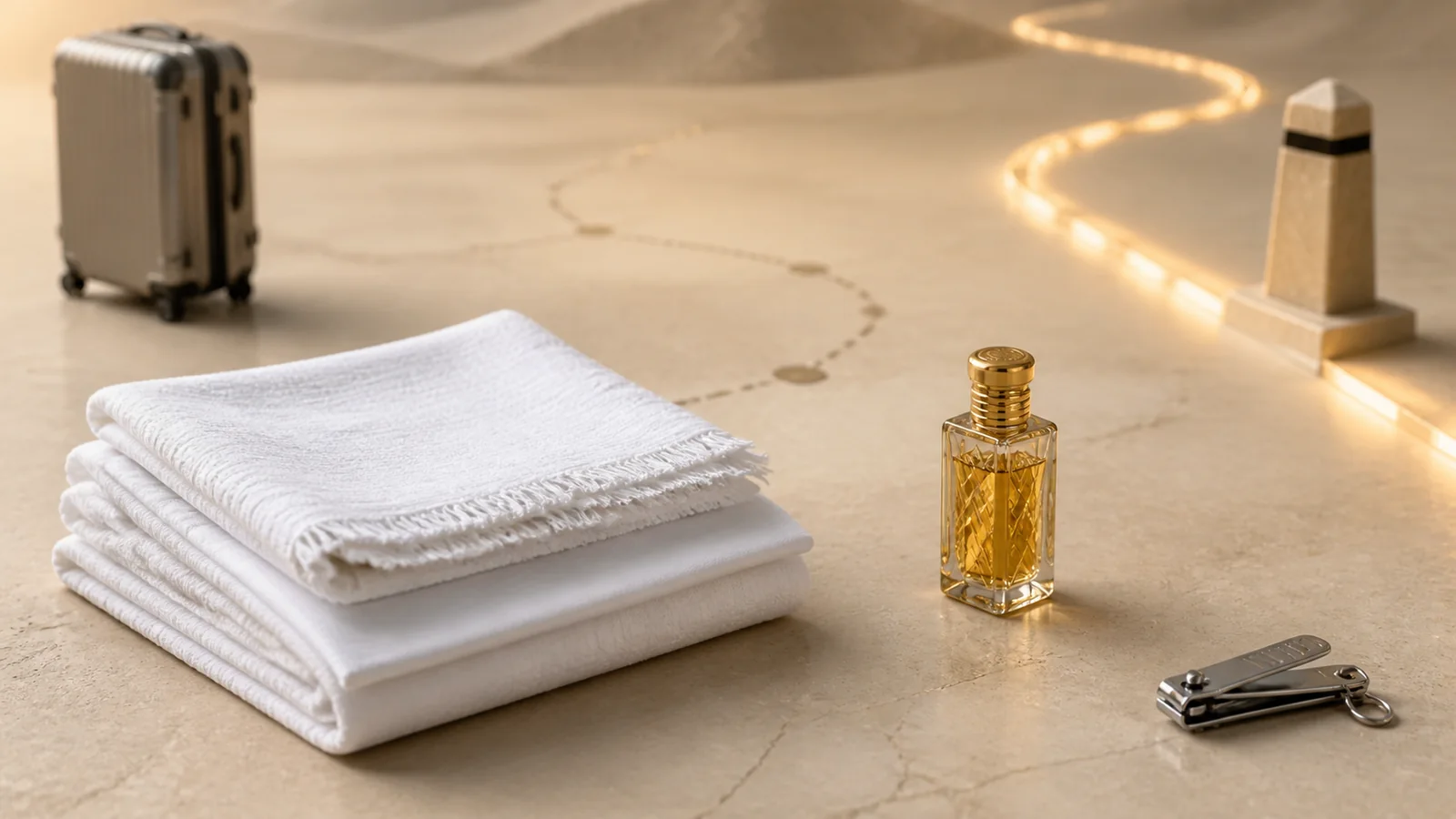
Keep the garments you need in accessible cabin baggage. A suitcase in the hold may remain unavailable through the entire period when preparation is needed, especially on connecting flights. Check your cabin allowance and retain the kit if a bag is checked at the gate.
Ibn Baz’s cited guidance distinguishes lack of garments from lack of ritual entry: the traveller should not deliberately pass the miqat without entering ihram simply because the correct clothing is unavailable. Correct the clothing when possible and ask a scholar about the consequences in your case.
Relying on a last-minute announcement
Do not wait for an announcement before starting a long change of clothes. Toilets may be occupied, the seat-belt sign may be on or an announcement may be missed. Ask the crew early how miqat information will be provided and have your kit ready.
Flight maps and alarms are aids, not a reliable sole method of identifying the boundary. If you cannot establish the precise moment, obtain guidance in advance and allow a margin by entering before it. See airport and aircraft preparation.
Using perfume after ritual entry
Check wipes, moisturisers, deodorants and hotel toiletries before using them in ihram. A product labelled “natural”, “hypoallergenic” or “alcohol-free” is not necessarily fragrance-free. Prepare suitable alternatives before travel.
The report about perfume before entering ihram does not authorise applying it afterwards. If you use a scented product by mistake, stop and remove it where reasonably possible without harming yourself. Tell a scholar whether it was accidental, what the product was and when it happened; do not invent a compensation amount.
Cutting nails or hair out of habit
Do routine grooming before entering ihram. Once in the ritual state, avoid casually clipping a nail or cutting hair. Keep grooming tools out of the pouch you use automatically during the flight.
A medical need, an intentional act, forgetfulness and hair that was already loose are not identical cases. The account of Kaab ibn Ujrah concerns a particular medical need to shave and the compensation prescribed for it. It is not a reason to delay necessary treatment or to apply the same ruling to every incident.
Thinking every stitched item is forbidden
“No sewn clothes” is an imprecise shortcut for male ihram clothing rules. The existence of a seam is not the decisive issue: ordinary shaped garments such as shirts and trousers are different from an ihram cloth with a hem. A belt, pouch or watch is not automatically prohibited merely because it contains stitching.
Learn the clothing rules from a reliable teacher before departure. Discuss a support brace, medical footwear or other necessary equipment individually rather than removing something important on the strength of a slogan.
Overlooking different rules for men and women
Male head coverings and ordinary fitted garments have their own restrictions. Women wear appropriate modest clothing; they are not required to copy the men’s two-cloth outfit or wear white. Bukhari 1838 specifies niqab and gloves among the restrictions for women in ihram.
Questions about face covering in particular circumstances or medically necessary protection should be discussed with a qualified scholar. Do not turn a brief clothing rule into a claim that all covering or all protective equipment has the same ruling. Our women’s clothing guide covers practical preparation.
Changing back before Umrah is complete
Leaving the mosque, taking a shower or reaching the hotel does not end ihram. For the normal Umrah sequence, complete the seven circuits of tawaf, the seven legs of sa‘i ending at Marwah, and the required shaving or trimming before leaving the ritual state.
If you are unsure whether a step was completed, ask before assuming the restrictions have ended. Consult the step-by-step Umrah guide and the qualified guidance you have chosen to follow.
Assuming one standard fidya covers everything
Different acts and circumstances can require different remedies, and scholarly schools differ on some details. Do not buy a sacrifice or start a particular fast solely because someone says it covers “any ihram mistake”.
Give the scholar a short factual account: your itinerary; when the Umrah plan became firm; where you actually entered ihram; what occurred and for how long; whether it was intentional, forgotten or unavoidable; which rites are complete; and any medical need. Ask what to do next and where any required action must take place.
Use a simple prevention routine
Before departure, separate clothing preparation from ritual entry, identify the miqat on your actual route, keep the kit in the cabin, choose fragrance-free toiletries and agree a reminder with your companions. Save a reliable religious contact.
Travelling from London, Paris, Toronto or New York does not create a different set of miqat rules. The practical challenge is the route and connection sequence, not the passport. Plan those details early so that worship is not reduced to a hurried change of clothes near landing.
Frequently asked questions
Does missing the miqat automatically invalidate Umrah?
Do not assume that. The remedy depends on what happened, whether returning is possible and other details. Seek qualified guidance promptly.
Does changing my ihram cloth end ihram?
No. Replacing the garments does not end the ritual state. Complete the prescribed Umrah steps before leaving ihram.
Does every mistake require a sacrifice?
No single rule covers every case. A qualified scholar needs the facts before explaining whether a remedy is required and what it involves.
Sources
- Sahih al-Bukhari 1524 — Miqat boundaries — The boundaries apply to those travelling through them for Hajj or Umrah.
- Sahih al-Bukhari 1542 — Clothing in ihram — Clothing restrictions for a male pilgrim.
- Sahih al-Bukhari 1838 — Clothing and perfume restrictions — Includes the prohibition of niqab and gloves for a woman in ihram.
- Sahih al-Bukhari 1539 — Perfume before ihram — Aishah’s report about perfume before entering ihram.
- Sahih al-Bukhari 1817 — Kaab ibn Ujrah’s case — A specific case of shaving for a medical need and its compensation, not a universal penalty table.
- Sahih al-Bukhari 1731 — Completing Umrah — Tawaf, passage between Safa and Marwah, and shaving or trimming.
- Ibn Baz — Crossing the miqat without ihram garments — Arabic scholarly guidance distinguishing missing garments from failure to enter the ritual state.
FAQ
Does missing the miqat automatically invalidate Umrah?
Do not assume that. The remedy depends on what happened, whether returning is possible and other details. Seek qualified guidance promptly.
Does changing my ihram cloth end ihram?
No. Replacing the garments does not end the ritual state. Complete the prescribed Umrah steps before leaving ihram.
Does every mistake require a sacrifice?
No single rule covers every case. A qualified scholar needs the facts before explaining whether a remedy is required and what it involves.